
Bai Marriage: From Proposal to Return Visit
We Bai people practice monogamy. We prefer to marry within our own ethnic group, but marriage with Han, Yi, and other ethnic groups is also allowed.
The wedding procedure goes: proposal → engagement → gift-giving → wedding ceremony → bridal chamber → return visit.
We Bai also have a custom of matrilocal marriage (the groom marries into the bride’s family). A son-in-law who marries into his wife’s family enjoys the same social status as any other man. He is respected by neighbors and the bride’s family, has the right to inherit the wife’s family property, and bears the responsibility of caring for his wife’s parents. At the time of engagement, the bride’s family elders publicly change the groom’s surname to match his wife’s, and assign him a generational rank according to his wife’s family. There is a folk saying: “Send the son away, welcome the son-in-law in.”
Crying Marriage: The Most Moving Song Before a Daughter Leaves Home
At a Bai wedding, there is one most moving moment, called crying marriage.
Before the bride leaves home, she sings crying marriage songs with her mother and sisters, expressing her reluctance to leave her family and her gratitude for her parents’ upbringing. The crying marriage songs include “crying for parents,” “crying for ancestors,” and “crying for the matchmaker.”
Crying marriage is not really crying out of sadness. It is a ritual, a form of expression. A daughter is about to leave the home where she grew up. Her heart holds reluctance, gratitude, and hope for the future—all sung into the crying marriage songs.
When a mother listens to her daughter’s crying marriage song, her heart is filled with mixed feelings. A daughter raised for more than twenty years is getting married today. How can a mother not feel heartache? But heartache aside, blessings must still be given.
Once the crying marriage songs begin, the whole family has tears in their eyes. This is the most moving part of a Bai wedding—not the noise and excitement, but family love.
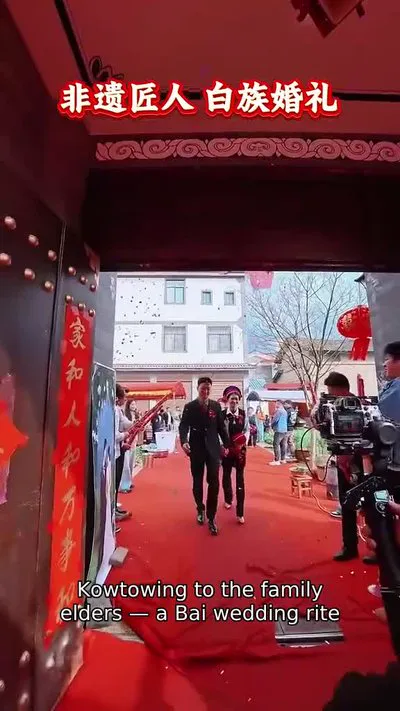
Bai wedding video still: the couple walks the red carpet, with bilingual subtitles.
Carrying the Bride: The Most Unforgettable Moment
The groom carrying the bride is the signature moment of a Bai wedding.
Whenever the bride and groom pass an intersection, people stop and wait for the groom to carry the bride in a figure-eight pattern. In some places, the best man greets the bridal party with suona horn music. When they arrive at the bride’s home, the suona must be played six times before the bride’s relatives come out to greet them.
I have attended many Bai weddings. Every time I see the groom carrying the bride across an intersection, my heart is moved. Carrying the bride is not just physical labor. It is the groom’s promise to the bride—from now on, I will carry you through life’s journey.
That kind of promise is made through action, not just words.
The Wedding Day: Celebration in Suona Music
On the wedding day, the groom’s family sets up a banquet early in the morning. After guests enjoy good food and rice wine, the groom and his best man toast table by table, with suona music playing continuously.
When the bride arrives at the groom’s home, she first goes upstairs to dress up, then enters the bridal chamber. Two boys of about ten years old rush into the bridal chamber holding pine torches, followed by the bride accompanied by her bridesmaids running into the chamber. Everyone playfully pinches the bride and teases her, full of joy.
The wedding celebration features Bawangbian dance and Dabenqu storytelling performances. Guests share tangyuan (glutinous rice balls), symbolizing reunion.
The liveliness of a Bai wedding comes from the heart. It is not for show. It is genuine happiness, genuine blessing.
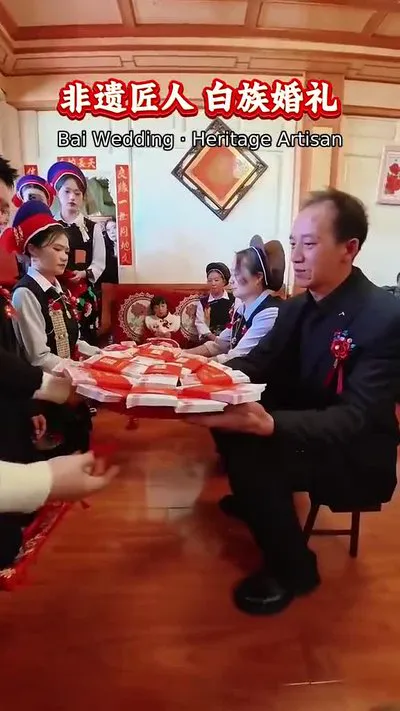
Bai wedding video still: the indoor tea ceremony, with Bai women in festive dress.
Silver Dowry: The Centerpiece of a Bai Wedding
Silver jewelry holds an important place in a Bai bride’s dowry, including silver bracelets, silver neck rings, silver earrings, silver headdresses, and a complete set of silver pieces.
Silver jewelry is both a symbol of wealth and a family inheritance and blessing for the bride. At a Bai wedding, the bride wears a complete set of silver jewelry, symbolizing good fortune and prosperity.
After years of making silver jewelry, what I love most is seeing a bride wearing a full set of silver jewelry. Sparkling silver earrings, bracelets, and neck rings, paired with a red and white wedding dress—that kind of beauty surpasses any other jewelry.
Because inside it lies the love of her parents’ family, the inheritance of the family, and blessings for a new life. A complete set of Bai wedding silver jewelry is often the result of years of savings by the bride’s family, and it is the most dignified dowry a young woman can bring when she marries.
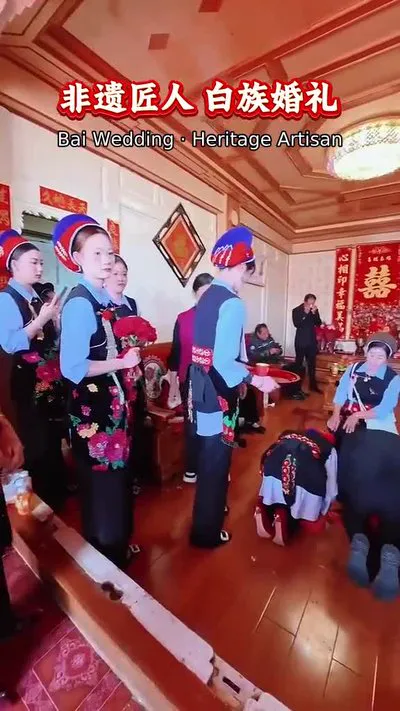
Bai wedding video still: the kowtow ceremony.
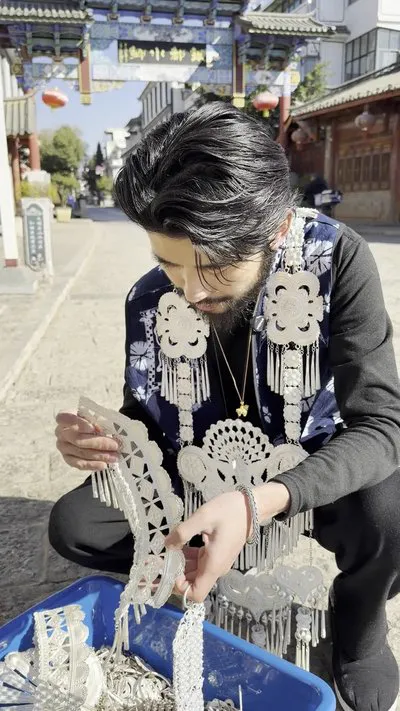
Mr. Jiang wearing a full set of silver jewelry under a silver archway—a classic example of bridal silver accessories.
On the third day after the wedding, the bride returns to her parents’ home (the return visit), accompanied by the groom or picked up by him the next day.
I am Mr. Jiang, founder of Yunsilver. My home is in Dali. The silver jewelry I make tells the stories of the Bai people. Website: yunsilver.com
Leave a Reply