Three Rooms and a Screen Wall: The House I Grew Up In
I grew up in a house built in the “three rooms and a screen wall” style.
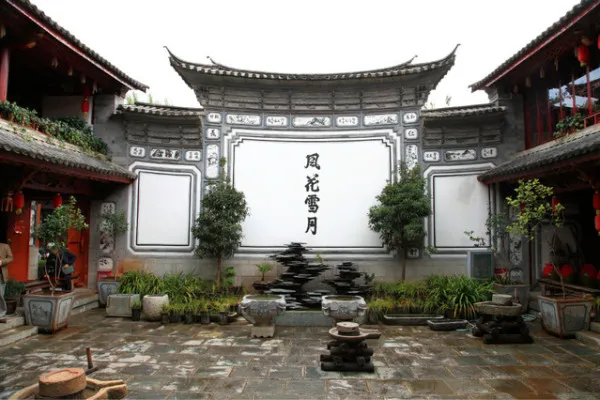
It is a courtyard enclosed by three two-story buildings (the main house and the left and right wing rooms) plus a screen wall. On both sides of the main house are corner rooms, and where they meet the wing rooms, small courtyards are formed.
A “fang” is the basic unit of a Bai courtyard—a building three bays wide and two stories high. Three fangs means the main house, the left wing, and the right wing.
When I was young, I played in the courtyard, enjoying the shade in summer and basking in the sun in winter. The courtyard was not large, but it held all my childhood memories.
Figure 1: Three rooms and a screen wall courtyard—main house and wing rooms surrounding the courtyard, screen wall inscribed with “Wind, Flower, Snow, Moon”
Four Compounds and Five Courtyards: The Grandeur of Great Mansions
The larger Bai residences follow the “four compounds and five courtyards” pattern.
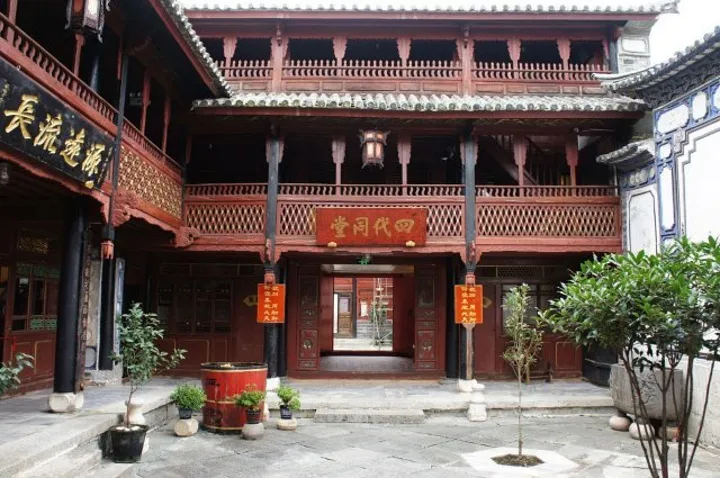
Four buildings enclose the space, with five courtyards in between (four small courtyards plus one large courtyard). This pattern is mostly used by wealthy families or great mansions.
The Xizhou Bai ancient building complex is located in Xizhou Town, Dali City, and was listed in the fifth batch of National Key Cultural Relics Protection Units in 2001. Famous residences include the Yang family courtyard, the Dong family courtyard, and the Yan family courtyard.
Every time I take friends to Xizhou to see these great mansions, I say: look, this is how particular Bai people are about building houses. It is not about being bigger, but about following the rules better.
Figure 2: Four compounds and five courtyards mansion—wooden buildings surrounding the courtyard, a plaque reading “Four Generations Under One Roof,” the grandeur of a great mansion
The Screen Wall: The First Thing You See Is Not the House
The screen wall is the soul of a Bai residence.
The first thing you see upon entering is not the house but the screen wall. The screen wall serves three functions: a feng shui barrier (blocking evil spirits and gathering good energy), a family symbol (inscriptions often read “fortune” or “passing down integrity through generations”), and an aesthetic display (paintings, calligraphy, clay sculpture).
Screen wall paintings feature landscapes, flowers and birds, auspicious patterns, and calligraphy. The screen wall of the Yan family mansion in Xizhou bears a large character for “fortune.”
Every time I come home and first see the “fortune” character on the screen wall, I feel at ease. It is the feeling of coming home, a familiarity engraved in my bones.
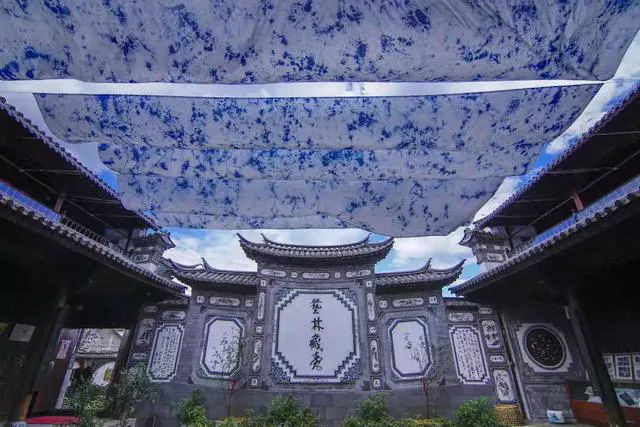
Figure 3: Bai screen wall with tie-dye cloth drying—screen wall paintings alongside Zhoucheng tie-dye cloth hung out to dry
Wood Carving: Art Carved Into Houses
Bai residences use an earth-wood-brick-stone structure, with white walls and gray tiles. Gate towers are elaborately decorated, often built with upturned eaves, layered brackets, and colorful paintings.
Bai people excel at wood carving, and their buildings use wood carvings extensively for decoration. Gate towers, window lattices, and beams and pillars all feature exquisite wood carvings—flowers, birds, fish, insects, and human stories are all carved into the wood.
I often stand before the gate tower of a Bai residence, looking up at those wood carvings, and can gaze at them for half a day without getting tired. Every cut is a craftsman’s effort; every picture is a story.
Windproof Wisdom: Coping With Dali’s Many Winds
Dali is windy; in the Xiaguan area, maximum wind speeds can reach Beaufort scale 12 (40 meters per second).
Bai residences face east with their backs to the west, with doors and windows opening to the east; the courtyard or “three rooms and a screen wall” layout shields the buildings from one another; the tall screen wall and the equal heights of the main house and wing rooms fully serve as wind protection.
Walls built with cobblestones are another feature, as the folk saying goes: “A wall built with cobblestones will not fall.”
Bai architecture is not beautiful for no reason; every design holds the wisdom of life. Wind protection, sun protection, energy gathering, beauty—all are considered. The wisdom of our ancestors is hidden in every brick and every tile.
I am Mr. Jiang, founder of Yunsilver. My home is in Dali. The silver jewelry I make tells the stories of the Bai people. Website: yunsilver.com
In the hearts of us Bai people, every village has a guardian god, called Benzhu.
Benzhu means “the noblest protector god of this territory.” In our Bai language, we call him “Duobo” (Grand Master) or “Laogu Laotai” (Great-great-grandfather, Great-great-grandmother).
Benzhu began as a protector god of clans and tribes, later evolving into the protector god of villages. Every village has its own Benzhu, guarding the land and the people.
Since childhood, I have followed adults to the Benzhu temple to burn incense. The temple was filled with incense smoke, and elders knelt devoutly, murmuring prayers. Back then I did not understand; I only felt that Benzhu was powerful and could bless our whole village with safety. Only when I grew up did I understand that what Benzhu blesses is actually our attachment to our hometown and our hope for life.
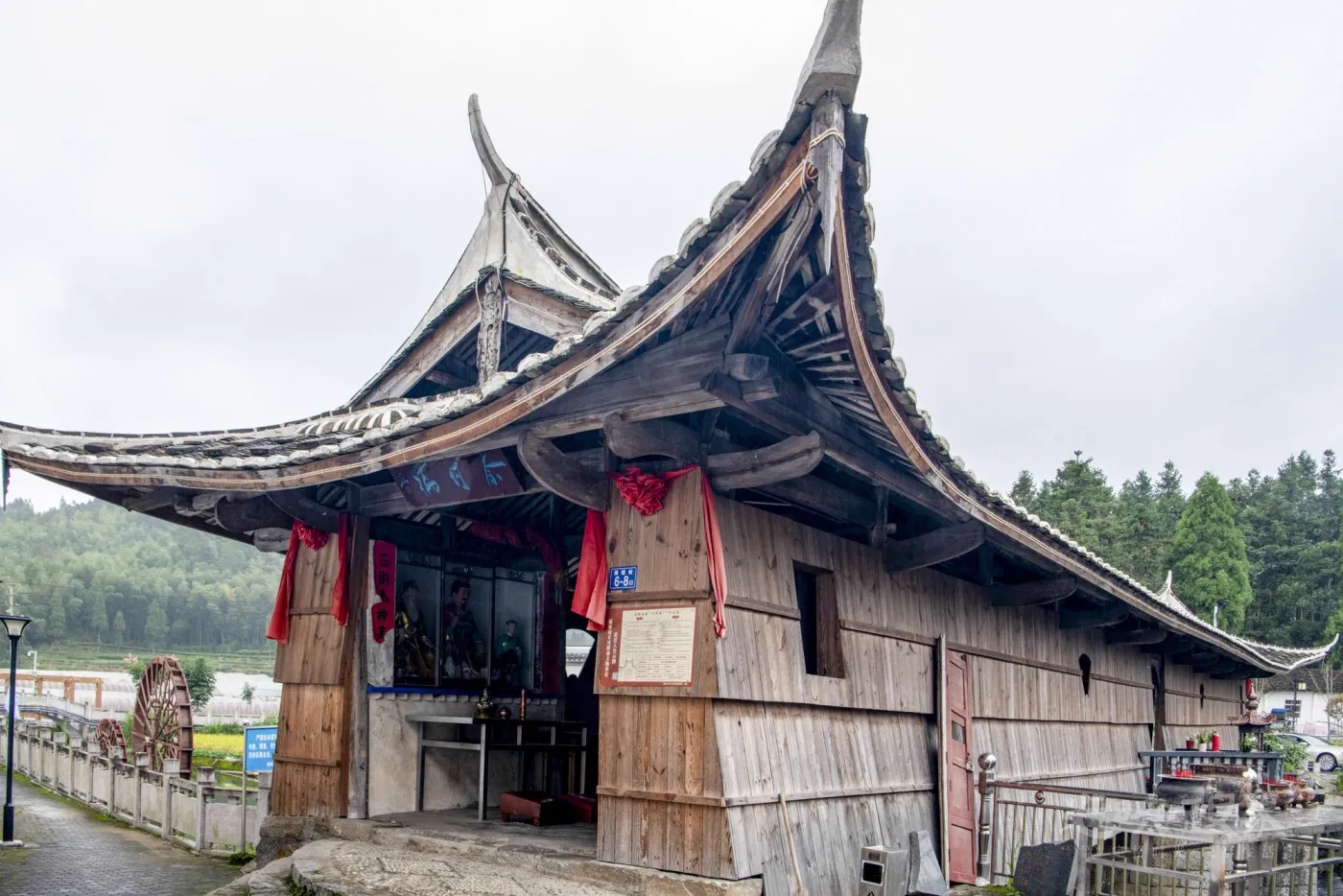
Figure 1: Bai Benzhu temple—wooden structure with upturned eaves, a deity statue in the shrine, red silk hanging high. The guardian god of every village lives here
Five Hundred Divine Kings: Our Pantheon
According to legend, our Bai Benzhu comprise five hundred deities, commonly known as the “Five Hundred Divine Kings.”
Above them are the “Seventy-two Altar Jingdi,” the “Eighteen Altar Gods,” and the “Nine Altar Gods,” with the highest Benzhu being the “Divine Heavenly Emperor.”
Benzhu come from eight sources: nature gods, ancestor gods, totem gods, hero gods, commoners deified, Buddhist and Taoist deities, rulers of the Nanzhao and Dali Kingdoms, and Han historical figures.
From heavenly gods to ancestors, from heroes to commoners, almost every worthy object of respect can become a Benzhu. This is precisely the inclusiveness of us Bai people—as long as you have contributed to this land, as long as you are worthy of respect, you can become our guardian god.
The First Benzhu Temple: A Tang Dynasty Story
In the Tang Dynasty, Nanzhao King Quan Fengyou ordered the state elder Zhao Wenqi to build the first Bai Benzhu temple in Dali.
From then on, Benzhu culture has been passed down through generations between Cangshan Mountain and Erhai Lake, continuing to this day.
More than a thousand years have passed, yet the Benzhu temple still stands, the incense still burns, and the Bai people’s reverence for Benzhu remains.
Buddhism: The Esoteric School That Came from Tibet, to the Azhali Sect
Buddhism was introduced to the Erhai region around the Sui and Tang dynasties, initially as esoteric Buddhism.
On this thread, there is a piece of history I must make clear: our Bai esoteric Buddhism came in through the Tibet route.
The Indian monk Zantuo Juduo from Magadha, in the sixteenth year of the Baohe era of Nanzhao (838 AD), came to Dali via Tibet. Nanzhao King Quan Fengyou trusted him greatly, appointed him as state preceptor, and married his clanswoman Princess Yuewu to him. From then on, under the protection of the Nanzhao royal family, the Azhali sect built many Buddhist temples, sculpted Buddha statues, and widely recruited Bai believers. Esoteric Buddhism flourished in Dali from then on, and successive generations served as state preceptors of Nanzhao and Dali.
Why via Tibet? Because at that time, Nanzhao and Tubo (Tibet) had very close exchanges. In the era of Geluofeng, Nanzhao, provoked by the encroachments of Tang border officials, turned to ally with Tubo. Political, military, and cultural exchanges between the two sides continued, and Buddhism followed this route from Tibet into the Erhai region. So our Bai esoteric Buddhism, from the very beginning, carried the imprint of the Tibet route.
The monks were called “Acharya,” also known as the “Azhali sect.” “Acharya” means mentor and model teacher. The Azhali sect and Tibetan Buddhism both belong to the esoteric lineage—both emphasize Guanyin, rituals, and master-disciple lineage. But when it reached Dali, combined with Bai culture, it formed its own distinctive school: worshipping Achaye Guanyin (the slender-waisted Guanyin), honoring Mahakala as guardian god, with monks allowed to marry and pass down through generations—very special in Buddhism, and our own Bai way.
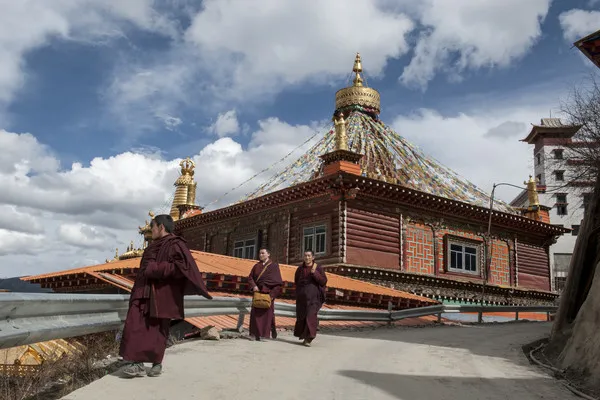
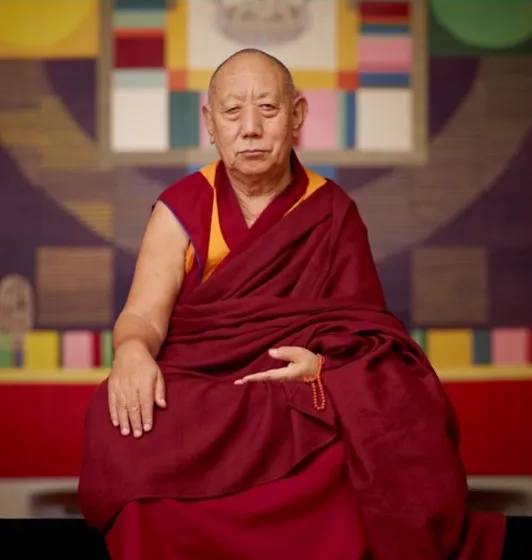
Tibetan Buddhist temple—red walls and golden roofs, prayer flags flying, lamas in crimson robes walking before the temple. Temples and lamas on the Tibet route can still be seen in the Dali region todayTibetan Buddhist lama—crimson robes, holding prayer beads. Esoteric Buddhism values master-disciple lineage; a good mentor is a path to the Dharma
Flourishing during the Nanzhao and Dali periods, ten of the twenty-two emperors of the Dali Kingdom became monks. The Erhai region early earned the title “Ancient Miaoxiang Kingdom.” Every household worshipped Buddha statues, everyone carried a string of prayer beads, and nearly half the days of the year were fasting days—that was daily life in Dali at that time.
Today, the shadow of Tibetan Buddhism remains clear in the Dali region: Tibetan Buddhist temples in northwest Yunnan, lamas coming to Dali on pilgrimage, prayer wheels, and thangkas all coexist harmoniously with Bai Benzhu temples and the Azhali sect. The line from Tibet, the line from India, the line from Han China converge in Dali, none excluding the others—this is what our Bai faith looks like.
The Three Pagodas of Chongsheng Temple are witnesses of Buddhism in Dali. Every time I visit the Three Pagodas, I wonder: more than a thousand years ago, did those emperors who became monks also stand here, looking at Cangshan Mountain and Erhai Lake, contemplating the meaning of life? And more than a thousand years later, the lamas’ chanting and the Benzhu temple incense still drift together over this land.
Silverwork and Faith: Craftsmen Crossing Mountains to Tibet to Make Ritual Objects
Here, I must also tell a story about the bond between our Bai silverwork and Tibetan Buddhism—because the tradition of Bai silver making was, to a large extent, developed to serve Tibetan Buddhism.
Traditionally, our craftsmen had to cross thousands of mountains and rivers to Tibet to make ritual objects for temples. Carrying chisels and hammers, they followed the Tea Horse Road westward, to Lhasa and to the great temples, making offering cups, butter lamps, dharma bells, and vajras for the temples. One ritual object could take months at the shortest, years at the longest. Craftsmen left their best skills for the Buddha, and their most devout hearts for the Buddha as well.
Why silverwork? Because in Tibetan Buddhism, silver is one of the purest and most solemn materials. Offering cups, lamp stands, and ritual objects for the Buddha, made of silver, are worthy of offerings before the Buddha. And our Bai silversmiths’ skills—chasing, hammering, inlaying—could carve Buddhist patterns into silver, chisel by chisel.
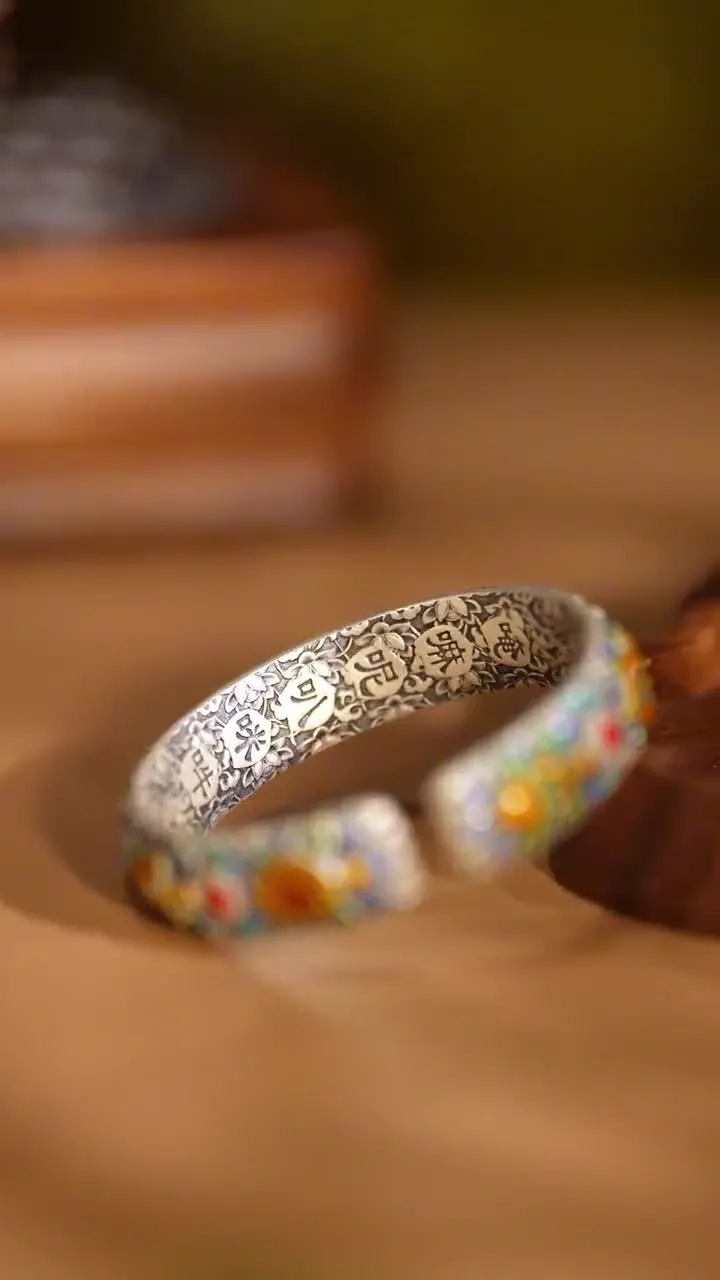
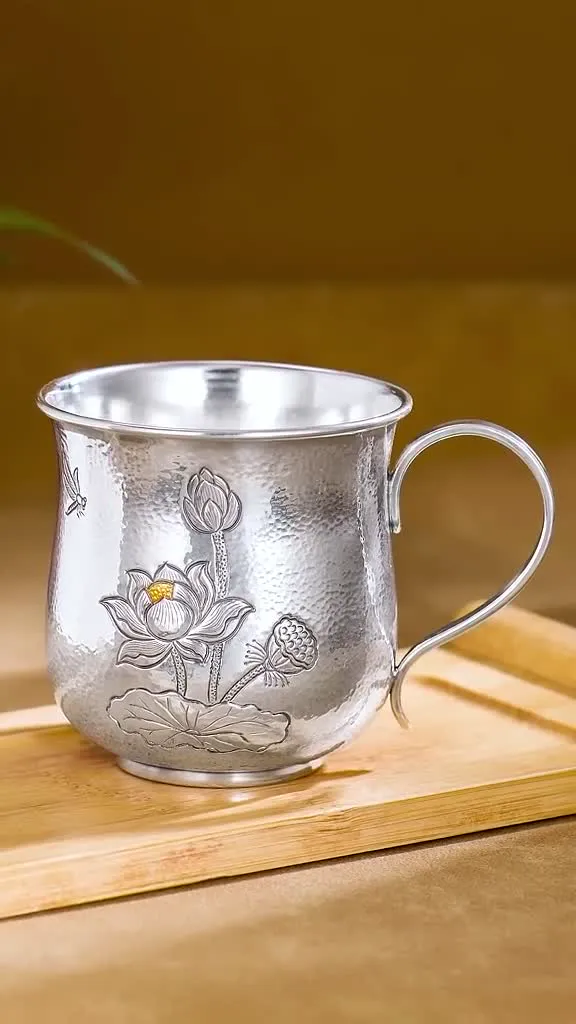
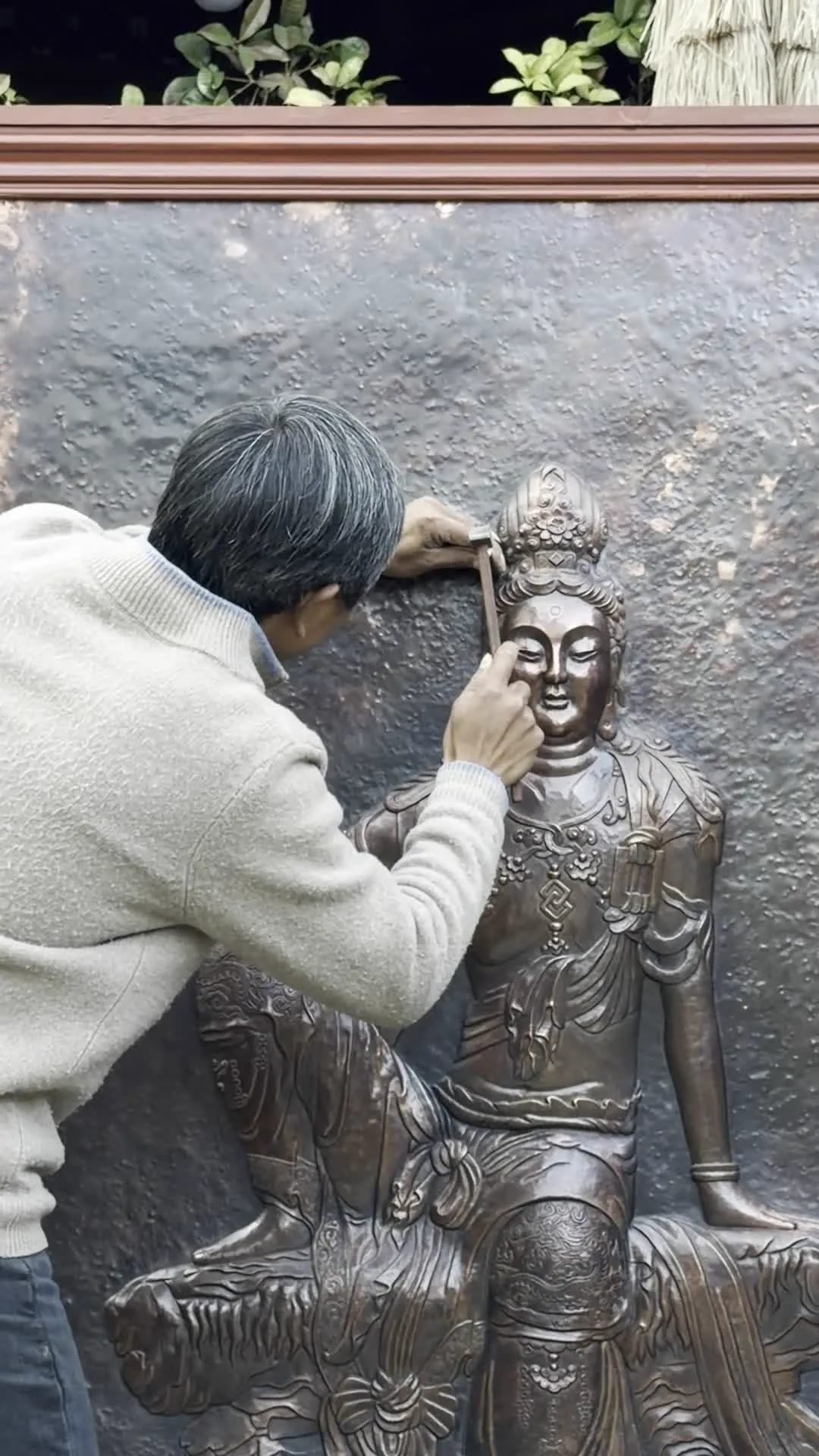
Auspicious Eight Treasures silver bangle—inner ring chased with the Eight Treasures pattern (parasol, golden fish, treasure vase, lotus, white conch, endless knot, victory banner, golden wheel), outer ring with colorful inlay. The Eight Treasures are the most important auspicious patterns in Tibetan Buddhism; wearing them on the wrist is wearing blessings on the bodyQinghe silver cup—body chased with lotus flowers, golden stamens, lotus pods, and lotus leaves. The lotus, unstained by the mud it grows from, is a symbol of Buddhist purity and one of the most common patterns on our silverworkCraftsman chasing Guanyin—a gray-haired craftsman holding a chisel, refining the face of a Guanyin image. Chisel by chisel, what is carved is not only the Guanyin on the copper plate, but the craftsman’s own devotion
The Eight Treasures, lotus flowers, Guanyin—these patterns appear on our silverwork not as decoration, but as faith. Behind every piece of silverwork with Buddhist patterns is a story of a craftsman crossing mountains and rivers, and a scene of a temple filled with incense.
I make silverwork, and I have taken up this thread as well. Silverwork is not just a commodity; it is a carrier of faith, a thread between the Bai people and Tibetan Buddhism. I hope that through silverwork, more people will come to know the Bai people, and to know this devotion that crosses thousands of mountains and rivers.
The Fusion of Three Teachings: Our Bai Inclusiveness
We Bai people have a characteristic: inclusiveness.
The “common origin of the three teachings” of Buddhism, Confucianism, and Taoism, and the “unity of all dharmas,” is a major feature of our Bai religious beliefs. In Benzhu temples, one often finds the Taoist God of Wealth, the Buddhist Mahakala, Guanyin, and others. Almost all the gods worshipped by Taoism have been accepted by us as Benzhu.
In a Benzhu temple, you can see Buddhist Guanyin, Taoist God of Wealth, and Benzhu statues sharing the same hall, coexisting harmoniously.
This inclusiveness is not just talk; it is engraved in our bones. We do not reject any faith, as long as it tends toward goodness and beauty and blesses the safety of a place, we welcome it.
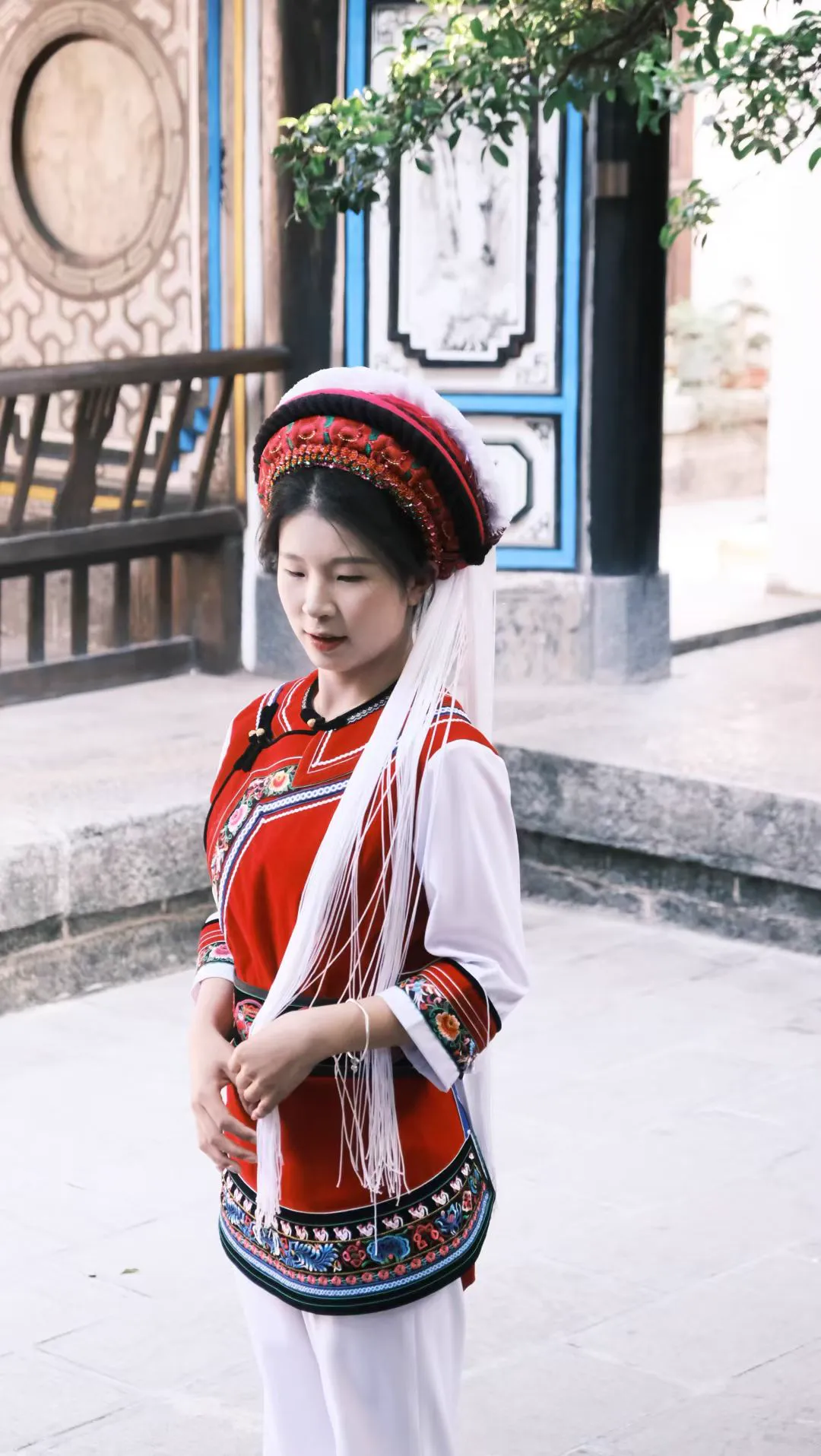
Figure 2: Bai girl in red standing before a traditional building with doors and windows—faith and daily life together
Benzhu Festival: The Village Carnival
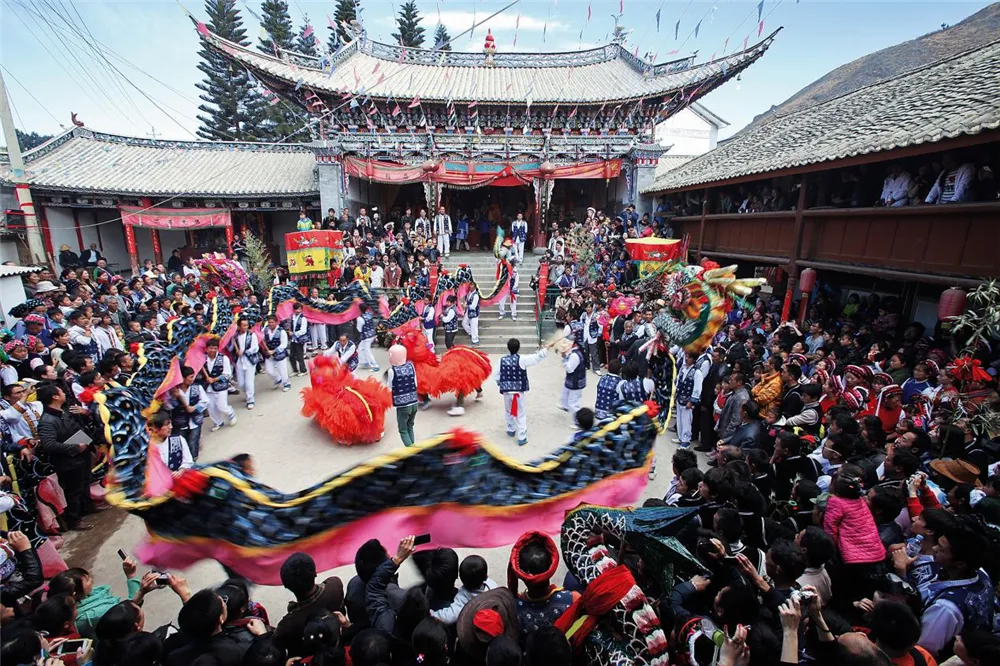
Every Benzhu has its own festival, called “Benzhu Gathering” or “Benzhu Festival,” mostly held on the Benzhu’s birthday or memorial day.
Villagers bring their children to the Benzhu temple to burn incense and offer sacrifices. Unmarried young men carry the Benzhu from the temple to the village communal house, where lion dances, dragon dances, stilt walking, singing of Dabenqu, and other activities take place.
The Benzhu Festival is not only a religious activity but also a social event for the village. Villagers scattered elsewhere reunite, young people meet each other, and the whole village is immersed in joy.
I love the Benzhu Festival most. The whole village comes out—elders chatting, children playing, young people singing and dancing. That kind of excitement, that kind of affection, cannot be experienced in the city.
Figure 3: Benzhu Festival temple fair—dragon and lion dances filling the grounds, men, women, young and old gathered before the temple. This is the village carnival
I am Mr. Jiang, founder of Yunsilver. My home is in Dali. The silver jewelry I make tells the stories of the Bai people. Website: yunsilver.com
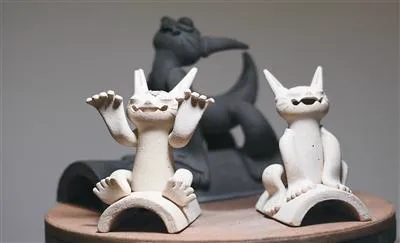
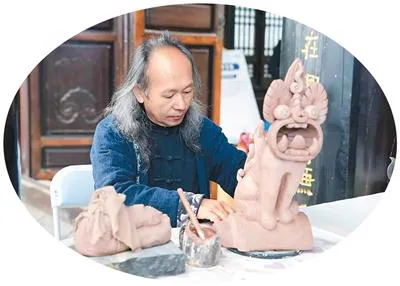
In rural Yunnan, on the rooftops of every household stands a kind of guardian beast called wamao.
Wamao are generally made of pottery clay, shaped, glazed, and fired in a kiln. They carry the dual meanings of guarding the home against evil and attracting wealth and fortune.
Wamao culture is widely distributed in Yuxi, Qujing, Dali, Chuxiong, Wenshan, and around Kunming in Yunnan, with a history of over a hundred years in the province. In 2022, it was listed as a Yunnan provincial intangible cultural heritage.
I grew up looking at the wamao on rooftops. Every time I looked up and saw a wamao, I felt especially at ease, feeling that with it there, the home was safe.
Although called a cat, the wamao is actually modeled on a fierce tiger—capturing “a cat’s face with a tiger’s spirit.”
Usually with mouth wide open and eyes round, it is meant to devour evil from all directions and welcome wealth. The reason it is called a cat and not a tiger is the saying “raising a tiger brings trouble,” while raising a cat (even one that looks like a tiger) is safe.
A pottery “cat” with the majesty of a tiger—this is the wonder of wamao. From afar, wamao look mighty and awe-inspiring, guarding the entire village.
The Rooftop Watchtower: Where Wamao Stand
Wamao are placed on the main ridge, flying eaves, or door lintel ridge tiles of rural Yunnan rooftops, serving as objects to ward off evil.
In many villages, most rooftops have wamao of different shapes, standing like watchtowers. From afar, the village rooftops are filled with wamao, like a team guarding the village.
Every time I return to the village and see the wamao on the rooftops from afar, I know I am home. That feeling is like seeing an old friend at the door waving to me.
The Consecration Ritual: Giving Wamao Spirit
Wamao are considered spiritual beings and must undergo a complete sacrificial ritual before they are said to have divine power, called “kaiguang” (consecration).
An auspicious even-numbered day must be chosen, in the second or eighth lunar month, and a duangong (ritual master) invited to perform the consecration. During the ritual, the duangong holds a red rooster and chants incantations, bites the rooster’s comb to draw blood, and drips the blood on the wamao’s eyes, nose, mouth, ears, and body, and places pine nuts, melon seeds, sorghum, and other items in the wamao’s mouth.
A wamao without consecration is just pottery; only after consecration does it gain spirit and truly guard the home against evil.
When I was young, I watched a consecration ritual once. The duangong’s chanting, the rooster’s crowing, the villagers’ prayers, all woven together—that solemn feeling I still cannot forget.
Craftsmanship: Slow Work, Fine Results
Wamao are mostly pottery, with a few made of stone. The hand-shaping process has many steps; only a few can be made in a day. The raw blanks must be dried in the shade, and kiln firing takes up space.
The protruding parts of wamao—ears, tongue, whiskers—break easily. Even slight damage is considered incomplete and spiritless, losing its evil-warding power, and it cannot be sold.
Every wamao is pinched by hand by a craftsman, one of a kind. Just like the silver jewelry we make, every piece is handmade and carries warmth.
Figure 2: Inheritor Su Longxiang holding tools to carve a large pottery wamao
Feng Shui Function: Devouring Negative Energy
Placed on rooftops, when a house is negatively affected by its surroundings (such as directly facing a tall building, called “qiang,” or sharp corners pointing at it, called “jianjiao sha”), a wamao facing the dangerous direction can devour the negative energy.
The hollow body of wamao symbolizes the ability to swallow gold and silver and attract wealth. The wide-open mouth can both devour evil and receive blessings.
Su Longxiang: Guardian of Wamao
Su Longxiang was born in Fengyi Town, Dali. He began learning pottery sculpture from his grandfather at age 10 and is now a Yunnan provincial intangible cultural heritage inheritor of wamao making.
He has created nearly 23,000 works, developed more than 200 kinds of wamao cultural and creative products (jewelry, fridge magnets, tea sets, etc.), and taught more than 200 apprentices. His works range from 2–3 centimeters to nearly 4 meters tall.
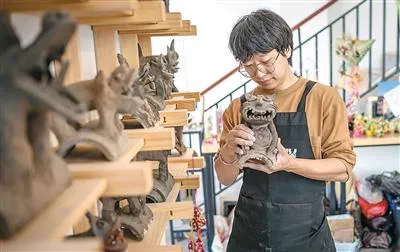
The Wamao Museum in Panlong District, Kunming, houses nearly 400 wamao from across Yunnan, each with a different form—some with neat square teeth looking gentle, some decorated with fish-scale patterns, horns, or wings, some so abstract that their prototype is hard to recognize.
From rooftop guardian beasts to museum artworks to cultural and creative products, wamao are entering more people’s lives. Just like our silver jewelry, traditional things, as long as they are passed down with care, will never become outdated.
Figure 3: Wamao museum display—many Yunnan wamao of different forms on shelves
I am Mr. Jiang, founder of Yunsilver. My home is in Dali. The silver jewelry I make tells the stories of the Bai people. Website: yunsilver.com
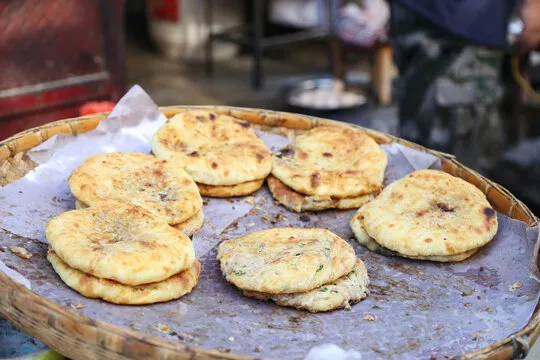
Also known as Xizhou crispy baba, it is a traditional delicacy of the Bai people in Dali. Round and flat, it is made by fermenting dough, rolling it into sheets, sprinkling fine salt or sugar, spreading lard, rolling it into strips, cutting and rolling it into round cakes, then baking them in a flat pan.
The sweet version is filled with rose sugar, the savory version wrapped with minced meat and scallions, baked over charcoal on both sides until the crust is crispy and layered and the inside soft. Overseas food lovers call it “Oriental pizza.”
Every time I return to Xizhou, the first thing I do is buy a freshly baked baba, hot to the touch, crispy, fragrant. That taste is the taste of childhood, the taste of home.
Figure 1: Xizhou Baba—golden round cakes on a bamboo tray, savory version with minced meat and scallions
Rushan: Milk Fragrance from the Grill
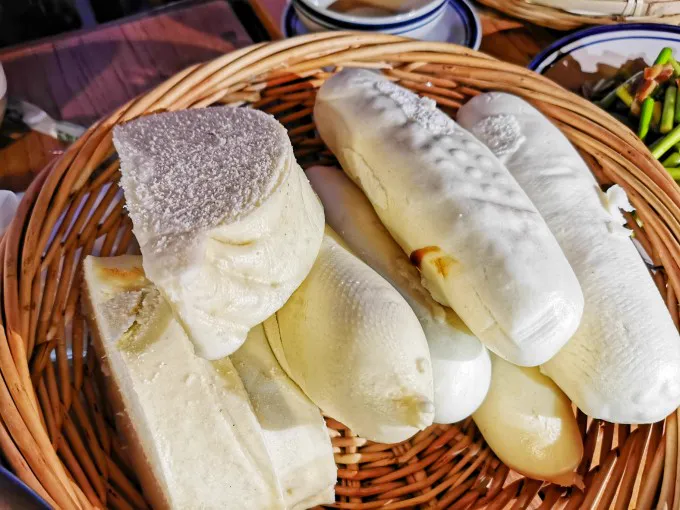
Rushan is a specialty dairy product of Dali, made from milk into thin sheets. Grilled, it tastes like a “grilled milk slice,” rich in milk fragrance, chewier with every bite.
It can be spread with rose jam or made into rose cheese desserts. On street stalls, the aroma of grilling rushan can be smelled from far away.
When I was young, I loved watching grandmothers grill rushan. The thin sheet slowly turned golden and crispy over charcoal, spread with rose jam, rolled up, and handed to me. That sweet fragrance, I still cannot forget it.
As famous as rushan is rubing, made from goat milk, fried and eaten, fragrant and crispy.
Figure 2: Rushan—grilled milk sheet rolls in a bamboo basket, rich milk fragrance
Sour and Spicy Fish: The Taste of Erhai Lake
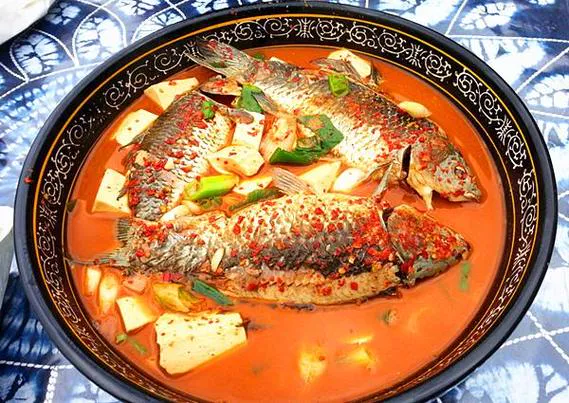
Sour and spicy fish is a representative Bai flavor—sour and spicy yet gentle, highlighting the ingredients themselves.
It uses Erhai bow fish, with red sour soup as its signature, served with potatoes, tofu, and other side dishes.
Fish from Erhai Lake, paired with Bai sour and spicy soup, is the taste of Dali. Every time friends visit Dali, I take them to eat sour and spicy fish. Watching them eat until they sweat yet unable to stop makes me truly happy.
Figure 3: Sour and spicy fish—red sour soup fish with tofu and green peppers, sour and spicy yet gentle
Shengpi: Only True Friends Dare to Eat It
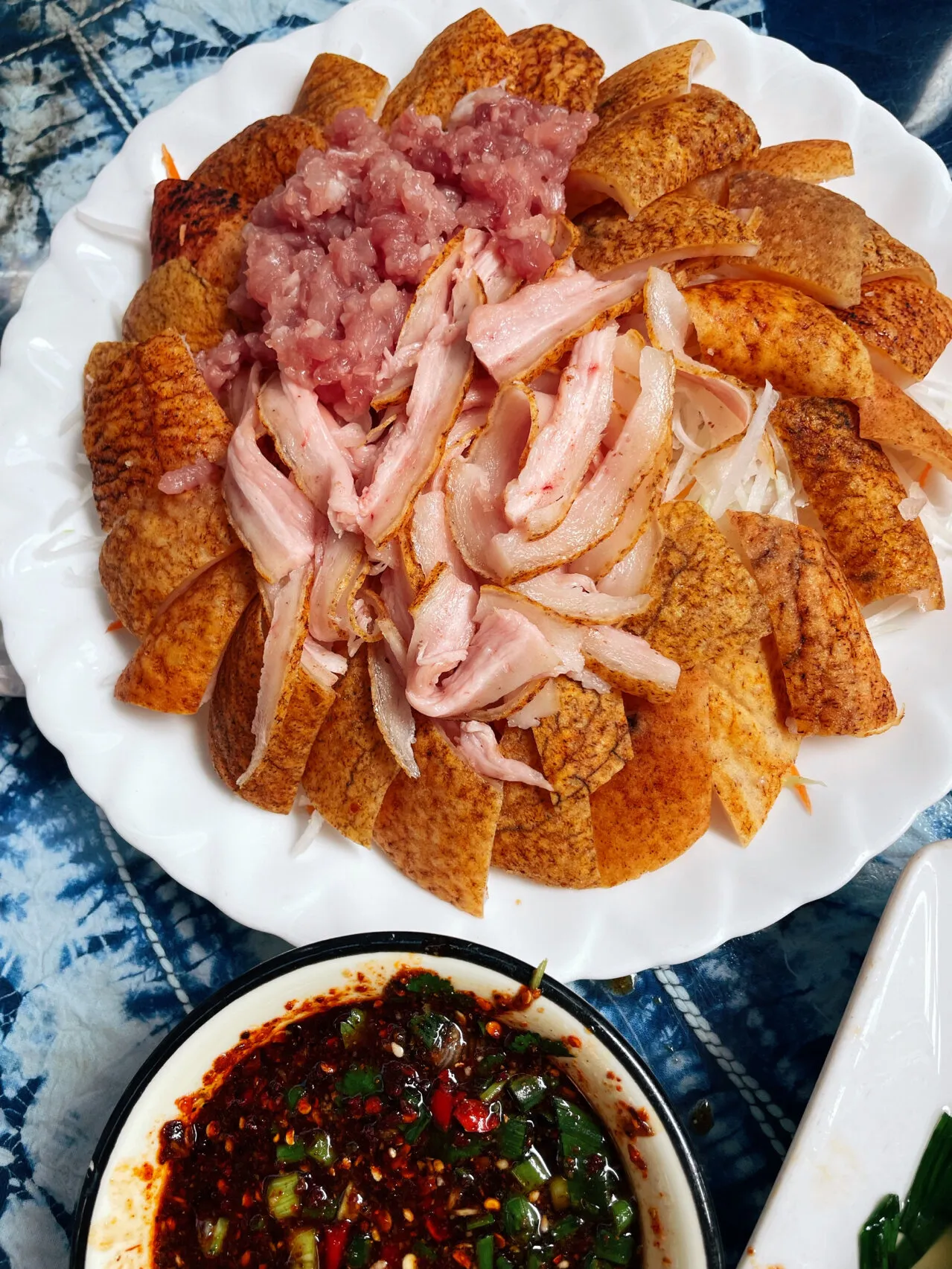
Shengpi is our Bai traditional “pork sashimi.”
The pork skin is crispy and fragrant, the raw meat cool, dipped in sour and spicy sauce made with plum vinegar—chewy, fresh, and sweet on the palate. The method: after slaughtering the pig, burn off the hair with rice straw, clean it, cut the meat and skin into pieces, and eat them directly with dipping sauce.
Xu Xiake’s Travel Notes mentioned shengpi. Today, pork must pass inspection before being eaten raw, to avoid parasites.
Not everyone dares to eat shengpi, but those who have tried it never forget the taste. I often tell friends: only those who dare to eat shengpi with me are true friends.
Figure 4: Shengpi—a white plate ringed with crispy pork skin, raw meat slices and minced meat in the middle, served with a bowl of sour and spicy dipping sauce
Three-Course Tea: One Bitter, Two Sweet, Three Aftertaste
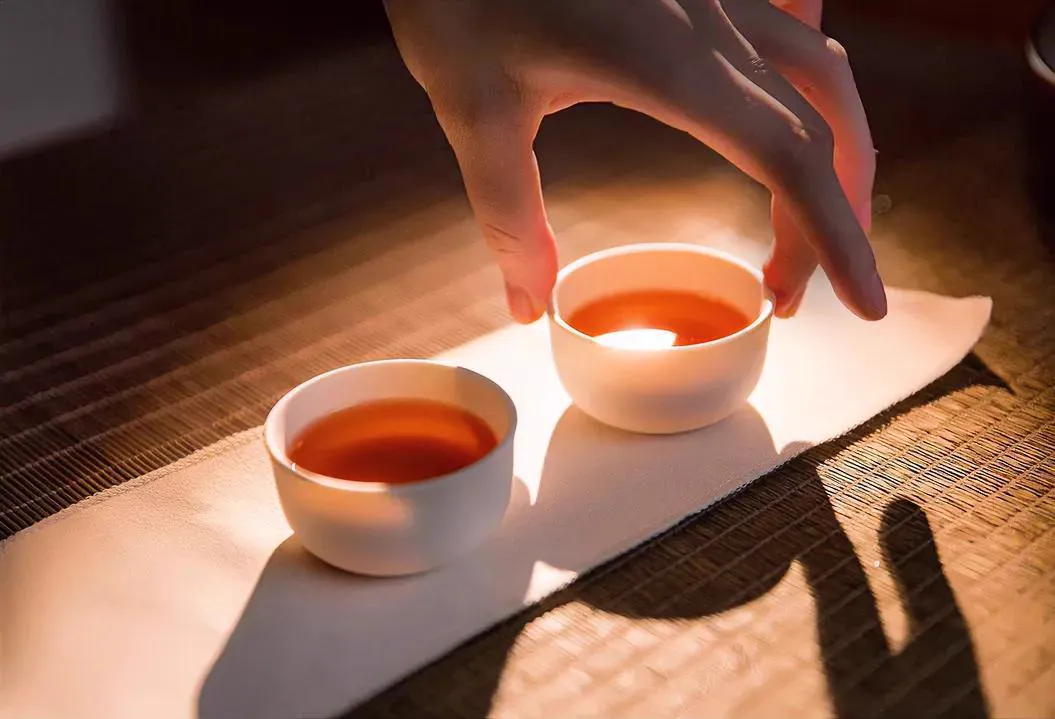
Three-course tea is our Bai custom for welcoming guests, consisting of bitter tea (roasted tea), sweet tea, and aftertaste tea.
It symbolizes “one bitter, two sweet, three aftertaste,” a philosophy of life. The first course is bitter, reminding people not to forget the hardships of starting a business; the second is sweet, celebrating the beauty of life; the third is aftertaste, reflecting on the meaning of life.
Bai people must serve three-course tea to guests. Not finishing all three courses means failing as a host.
Every time I host friends from afar, I personally brew three-course tea for them. Watching them go from frowning to relaxing to contemplating, I know they understand the meaning of three-course tea, and the life philosophy of us Bai people.
Figure 5: Three-course tea—pouring tea into a small white porcelain cup, amber tea, warm light on a bamboo mat
Staples and Preserved Foods: Everyday Tastes
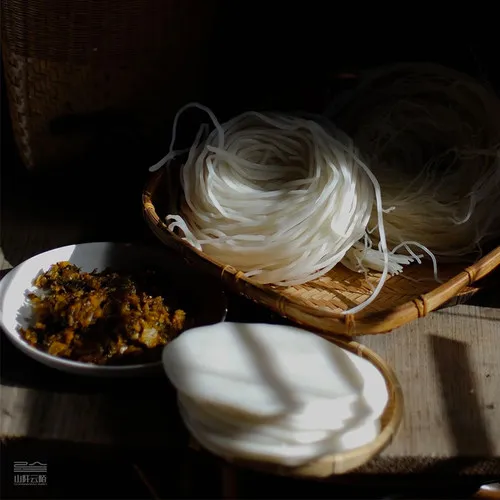
Our Bai staples are diverse. In the plains, rice is the staple; in the mountains, corn and buckwheat are more common.
Snacks include rice noodles, er si, er kuai, ice jelly, liang xia, juan fen, pea jelly, and more, prepared differently in different places. Hand-kneaded er kuai costs 3 yuan a serving, and can be topped with fermented tofu, spicy sauce, shredded potatoes, or minced meat.
Bai people have the custom of pickling and air-drying foods for preservation. The diet includes many pickled, cured, and dried foods, such as pickled pork intestines, pickled plums, pickled pears, cured meat, cured sausage, dried fish, dried pickled vegetables, and more. For Chinese New Year, five-flower pickled vegetables must be prepared.
These everyday tastes make up our Bai life. Not grand meals, not feasts, just the rice noodles, er kuai, and pickled vegetables eaten every day—but that taste is incomparable to any delicacy.
Figure 6: Rice noodles and er kuai—a bamboo basket of rice noodles, er kuai, and small dishes of pickled vegetables, everyday tastes
I am Mr. Jiang, founder of Yunsilver. My home is in Dali. The silver jewelry I make tells the stories of the Bai people. Website: yunsilver.com
Cangshan Mountain and Erhai Lake: The Scenery I Grew Up With
Cangshan Mountain lies to the west of Dali City, and Erhai Lake lies to the east, forming the famous “Wind, Flower, Snow, Moon” landscape of “Cangshan snow and Erhai moon.”
Cangshan has nineteen peaks and eighteen streams, with the highest peak, Malong Peak, at 4,122 meters above sea level. Erhai Lake is China’s seventh-largest freshwater lake, covering about 250 square kilometers.
I grew up looking at Cangshan Mountain and Erhai Lake. In the morning, the snow on Cangshan glitters in the sunlight; in the evening, the moon over Erhai is reflected in the water. That beauty is carved into my bones.
The snow on Cangshan never melts all year round, and the moon over Erhai is mirrored in the lake. The wind of Xiaguan, the flowers of Shangguan, the snow of Cangshan, and the moon of Erhai together make up “Wind, Flower, Snow, Moon”—the synonym for Dali and the inspiration for the Bai girls’ headdress.
Figure 1: The Three Pagodas of Chongsheng Temple reflected in Erhai Lake, with Cangshan Mountain in the background
Dali Ancient City: Capital of the Nanzhao and Dali Kingdoms
Dali Ancient City lies at the foot of Cangshan Mountain and on the shore of Erhai Lake. It was first built during the Nanzhao period of the Tang Dynasty, originally the Nanzhao capital of Yangjumie City.
In 1982, it was listed among China’s first batch of National Historical and Cultural Cities. Inside the ancient city are Wuhua Tower, Foreigners’ Street, Fuxing Road, and more, with well-preserved city walls and gates.
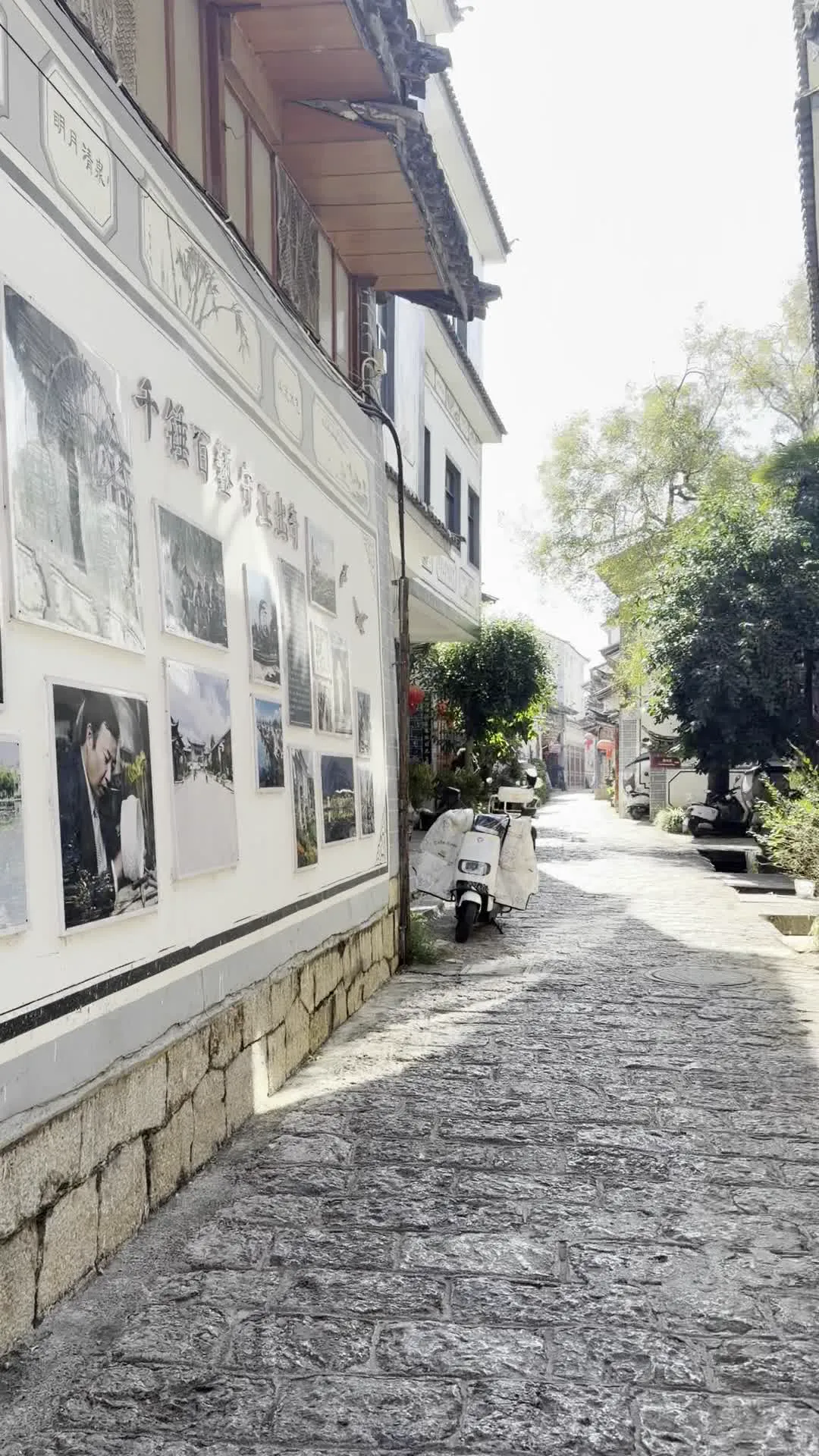
Walking along the bluestone streets of the ancient city, both sides are Bai residences turned into shops, selling tie-dye, silver jewelry, and milk fan. The ancient city is not large, but every stone has a story.
Every time I take friends around the ancient city, I say: don’t be fooled by how lively this ancient city looks now—more than a thousand years ago, this was the capital of the Nanzhao Kingdom, the center of the entire southwest.
Xizhou Ancient Town: A Museum of Bai Residences
Xizhou Ancient Town lies on the northwest shore of Erhai Lake, on the road north from Dali City, and has been a Bai settlement since ancient times.
The Xizhou building complex is a typical Bai residence, characterized by “three rooms and a screen wall, four courtyards and five patios.” In 2001, it was listed as a National Key Cultural Relics Protection Unit.
Xizhou baba and Xizhou crispy baba are local famous foods. Visiting Xizhou without eating baba and seeing the residences means you haven’t really been here.
Every time I return to Xizhou, I walk through the old houses. Those three-room-and-screen-wall houses, those carved wooden gate towers, those “Fu” (fortune) characters on the screen walls—they are all memories of my childhood.
Xinhua Village: Home of Chinese Silverwork
Xinhua Village, in Dali Prefecture, is a famous Bai silver-making village, known as the “Home of Chinese Silverwork.”
Every household in the village works in silver processing, from melting silver, forging, chasing, and engraving to polishing—all done entirely by hand.
Yunsilver is located in Dali. The silversmiths here learn the craft from childhood, mastering chasing, forging, and inlaying. Every piece of 999 handmade fine silver comes out of Dali.
I often tell my friends: the silversmiths of Xinhua Village are the best silversmiths in China. Not because their technique is the best, but because they put in the most care. Every piece of silver jewelry is made with a lifetime of craftsmanship.
Dali Bai Autonomous Prefecture: The Map of My Hometown
Dali Bai Autonomous Prefecture governs Dali City, eight counties including Xiangyun, Binchuan, Midu, Yongping, Yunlong, Eryuan, Jianchuan, and Heqing, and three ethnic autonomous counties: Yangbi, Weishan, and Nanjian.
Each county has its own character: Jianchuan’s wood and stone carving, Dali’s silverwork, Xizhou’s residences, Zhoucheng’s tie-dye.
Erhai Ecological Corridor and Shuanglang
The Erhai Ecological Corridor stretches about 129 kilometers around the lake. Cycling along it, you pass Caicun Pier, the S-curve of Panxi Village, Little Putuo, Shuanglang Ancient Town, and other scenic spots.
In the middle section of the western corridor are lesser-known attractions like Shuangyuan Creek Wetland, Haishen Park, and Gusheng Village.
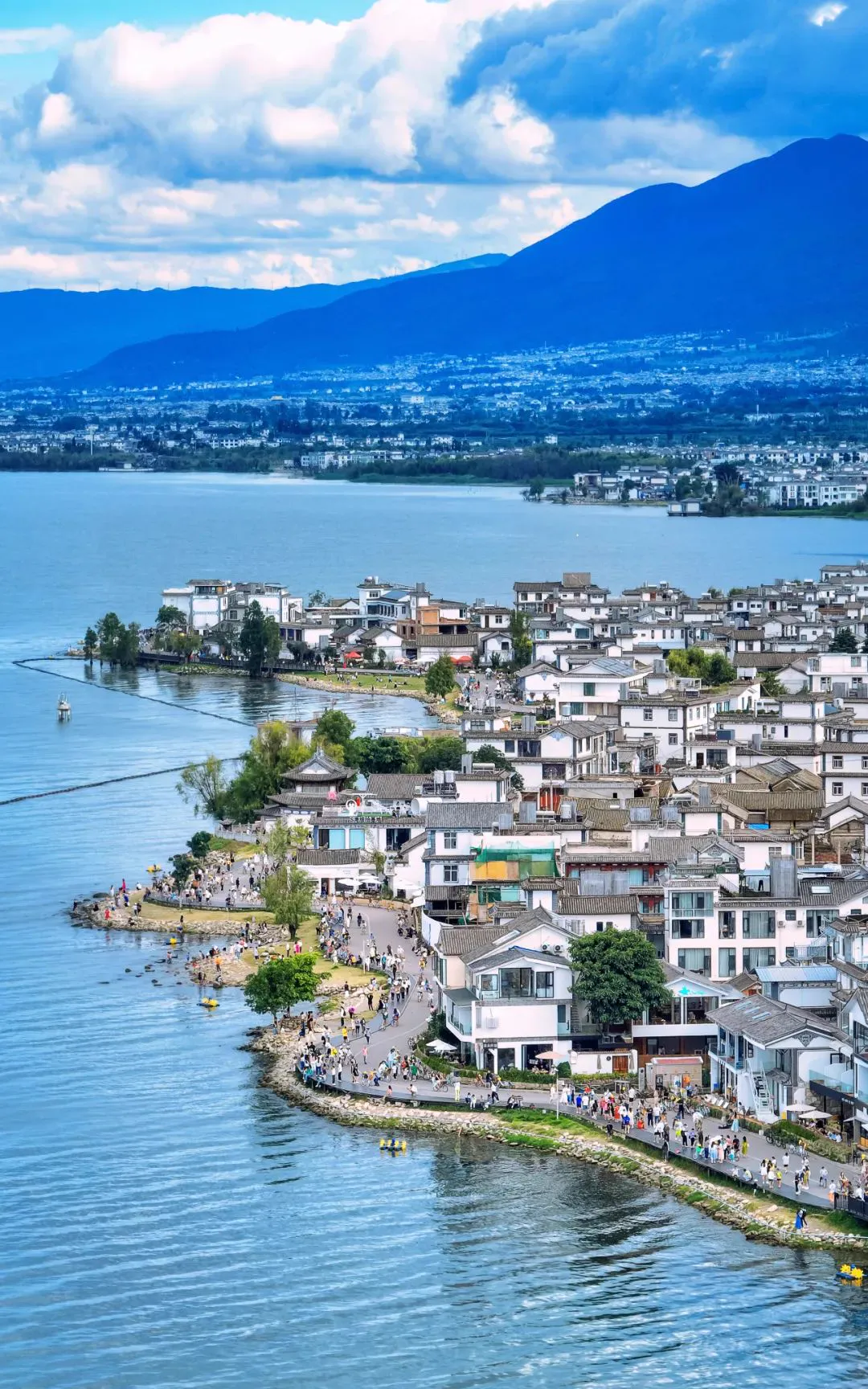
Shuanglang Ancient Town lies on the eastern shore of Erhai Lake, famed as “the beauty of Dali lies in Cangshan and Erhai, and the beauty of Cangshan and Erhai lies in Shuanglang.” Yang Liping’s Sun Palace and Moon Palace are located in Shuanglang.
Figure 2: A lakeside village by Erhai Lake with a long corridor, Cangshan Mountain in the background
Climate and Best Time to Visit
Dali has a low-latitude highland monsoon climate, with spring all year round.
The best times to visit are March to May (rapeseed flower and cherry blossom seasons) and September to November (crisp autumn air, golden season for photography).
No matter when you come to Dali, Cangshan Mountain and Erhai Lake will be there, Bai villages will be there, and the sound of silversmiths’ hammers will be there too.
My home will always be waiting for you in Dali.
Figure 3: Morning light over Erhai Lake—snow-capped Cangshan peaks, lakeside villages, and a small boat in the morning light
I am Mr. Jiang, founder of Yunsilver. My home is in Dali. The silver jewelry I make tells the stories of the Bai people. Website: yunsilver.com
The March Street Fair is the grandest festival for us Bai people.
It is held from the 15th to the 20th day of the third lunar month each year, at the foot of Zhonghe Peak of Cangshan Mountain, west of Dali City. It originated in the Tang Dynasty as a Guanyin temple fair and has a history of more than a thousand years.
Li Yuanyang’s “Yunnan Gazetteer” of the Ming Dynasty records: “The Guanyin Market, held on the 15th day of the third month at the foot of Cangshan, trades goods from all provinces. Since the Yonghui era of the Tang Dynasty to today, dynasties have changed, but this market has never changed.”
In 1991, the March Street Fair was designated as the “March Street Ethnic Festival.”
Originally a Buddhist temple fair with sutra chanting and worship, the March Street Fair gradually evolved into a goods exchange fair, becoming the largest trade event in western Yunnan, while also hosting horse racing, archery, song and dance, dragon boat racing, and other cultural and sports activities.
Since childhood, I have followed adults to the March Street Fair. Crowds of people, shoulder to shoulder, selling everything imaginable. That kind of excitement, that kind of popularity, is something you cannot experience on ordinary days.
Figure 1: Ancient town street scene—stone-paved road, white walls with photo displays, Bai residences. The March Street Fair has been held on streets like this for over a thousand years
Torch Festival: My Favorite Flame
The Torch Festival is my favorite festival.
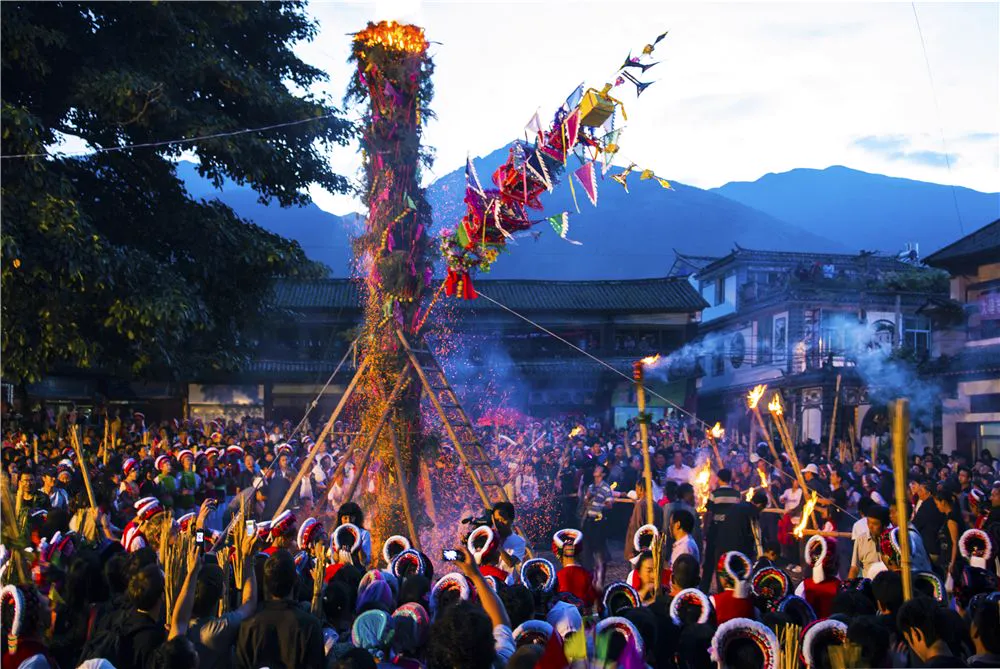
In the Bai language, it is called “Fuwangwu,” held on the 25th day of the sixth lunar month each year. On the eve of the festival, the whole village erects a large torch, ten to twenty meters high, made from a pine tree trunk, wrapped with wheat straw and pine branches, with a flag on top and three paper lanterns strung on the flagpole, symbolizing promotion through three levels.
On the festival day, men and women, young and old, worship ancestors through activities like paying respects to the torch, lighting the torch, playing with the torch, and jumping over the torch, praying for abundant harvests and thriving livestock.
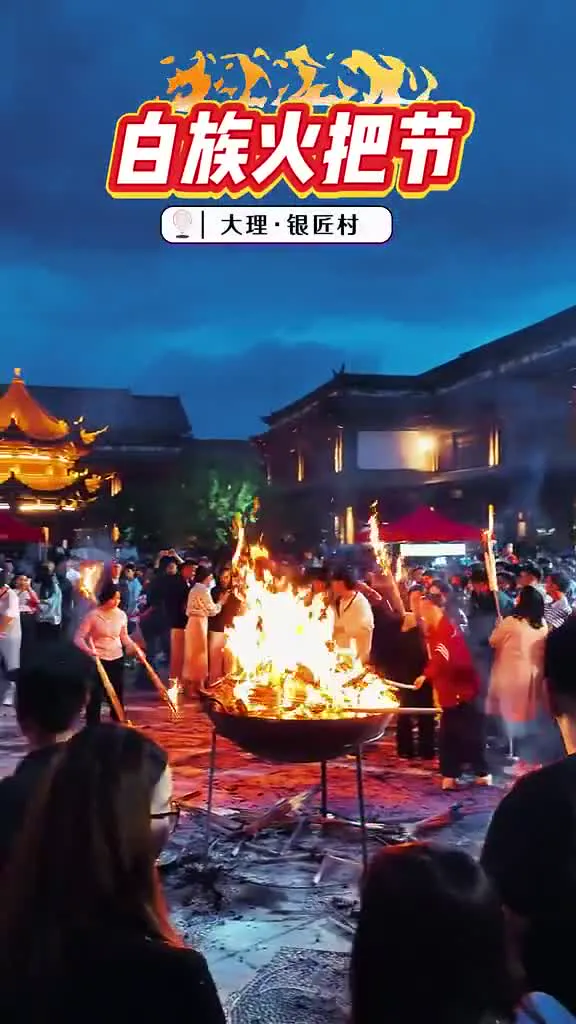
At noon, people take small torches, paper money, incense, candles, and offerings to ancestral graves to sweep tombs and pay respects; before sunset, they admire the torches and horse racing, running around the torch three times; at nightfall, elders lead the sacrifice, and brave young men climb the large torch to light it; the climax is playing with torches, when young people grab pine resin powder and sprinkle it on the torch, flames licking toward each other, called “offering a handful,” believed to burn away bad luck; the finale is jumping over torches, when young men and women leap over bonfires, praying to ward off disasters and evil.
Every time the torch is lit, the whole village cheers. Flames shoot to the sky, illuminating the night and every face. That feeling is truly hard to describe in words.
Figure 2: Bai Torch Festival large torch—towering torch with colorful flags, crowds wearing Bai Wind-Flower-Snow-Moon hats holding small torches, Cangshan Mountain in the background
Raosanling: Pilgrimage to the Divine Capital
Raosanling is held in late April of the lunar calendar each year, lasting three to four days.
Thousands of men and women, young and old, dressed in ethnic finery, playing instruments, singing and dancing, gather at the “Divine Capital” Shengyuan Temple to worship.
According to legend, Duan Zongbang, a general of Nanzhao and ancestor of the Duan family of the Dali Kingdom, is the supreme god of the Bai people. His temple is called the “Divine Capital,” built at Shengyuan Temple on Shangyang Creek. Over three days, pilgrims visit Shengyuan Temple, Jingdi Temple (Jinkui Temple), and Chongsheng Temple respectively.
During Raosanling, the whole of Dali comes alive. Songs, music, and laughter drift between Cangshan Mountain and Erhai Lake.
Shibao Mountain Song Festival: Love Songs Across the Valley
Held for three days at the end of July of the lunar calendar each year at Shizhong Temple on Shibao Mountain in Jianchuan.
Tens of thousands of young men and women gather in groups to sing antiphonal mountain songs, using three-stringed instruments and songs to convey affection. The song festival originated in the Nanzhao period and is an important occasion for Bai young people to fall in love and make friends.
When I was young, I also went to the Shibao Mountain Song Festival. That feeling was wonderful—singing across the valley, getting to know each other through song, and falling in love through knowing each other. Mountain songs are how we Bai people fall in love.
Festival Density: Our Life Is Festivals
The Bai region has many festivals, temple fairs, and song gatherings.
From the Spring Festival to the 18th day of the first lunar month, there are festivals almost every day and dragon lantern dances every night; from the first month to the start of transplanting, there are temple fairs every month, with villages welcoming and sending off their Benzhu gods for Benzhu Festivals.
Our Bai year is spent in festivals. Every festival is a reunion, and every reunion is a celebration.
Figure 3: Bai Torch Festival bonfire night gathering—the whole village celebrating together
I am Mr. Jiang, founder of Yunsilver. My home is in Dali. The silver jewelry I make tells the stories of the Bai people. Website: yunsilver.com
“Bai” (white) in our language means nobility, purity, and cleanliness. We call ourselves “Baihuo,” which means “white people.”
Bai girls wear white blouses, Bai young men wear white shirts, and Bai houses have white walls. White is the base color of our ethnic group.
Every time I see a Bai girl in a white blouse and red vest walking through the village, my heart feels especially at ease. That cleanliness, that freshness, is beyond compare with any other color.
Men’s Clothing: The Elegance of “Three Drops of Water”
Men in the Dali region mostly wear white Mandarin-collar shirts, with black-collar jackets on top, or several leather or silk jackets, commonly known as “three drops of water.”
They wear leather belts or embroidered belly bands at the waist, and blue or black trousers below. Every adult man carries an embroidered pouch at his side, embroidered with patterns like “two sparrows on a branch” or “mandarin ducks playing in water.”
The pouch is embroidered by a girl for her sweetheart. How well a man’s pouch is embroidered reflects on the reputation of the girl who embroidered it. So when Bai girls embroider pouches, they put in their utmost care.
Women’s Clothing: Red and White, the Classic Combination
Women in the Dali region mostly wear white blouses with red vests, or light blue blouses, with black velvet collar jackets on top, embroidered short aprons at the waist, blue wide-leg trousers below, and embroidered “hundred-section shoes” on their feet.
The red-and-white combination is the most classic in Bai clothing. White represents nobility and purity, red represents festivity and good fortune, blue represents Erhai Lake, and black represents steadiness.
When a Bai girl wears red-and-white clothing and stands between Cangshan Mountain and Erhai Lake, the scene is as beautiful as a painting.
Figure 1: Bai girls in festival dress lined up—red-and-white colors with embroidered vests
The Wind-Flower-Snow-Moon Headdress: Wearing Dali on Your Head
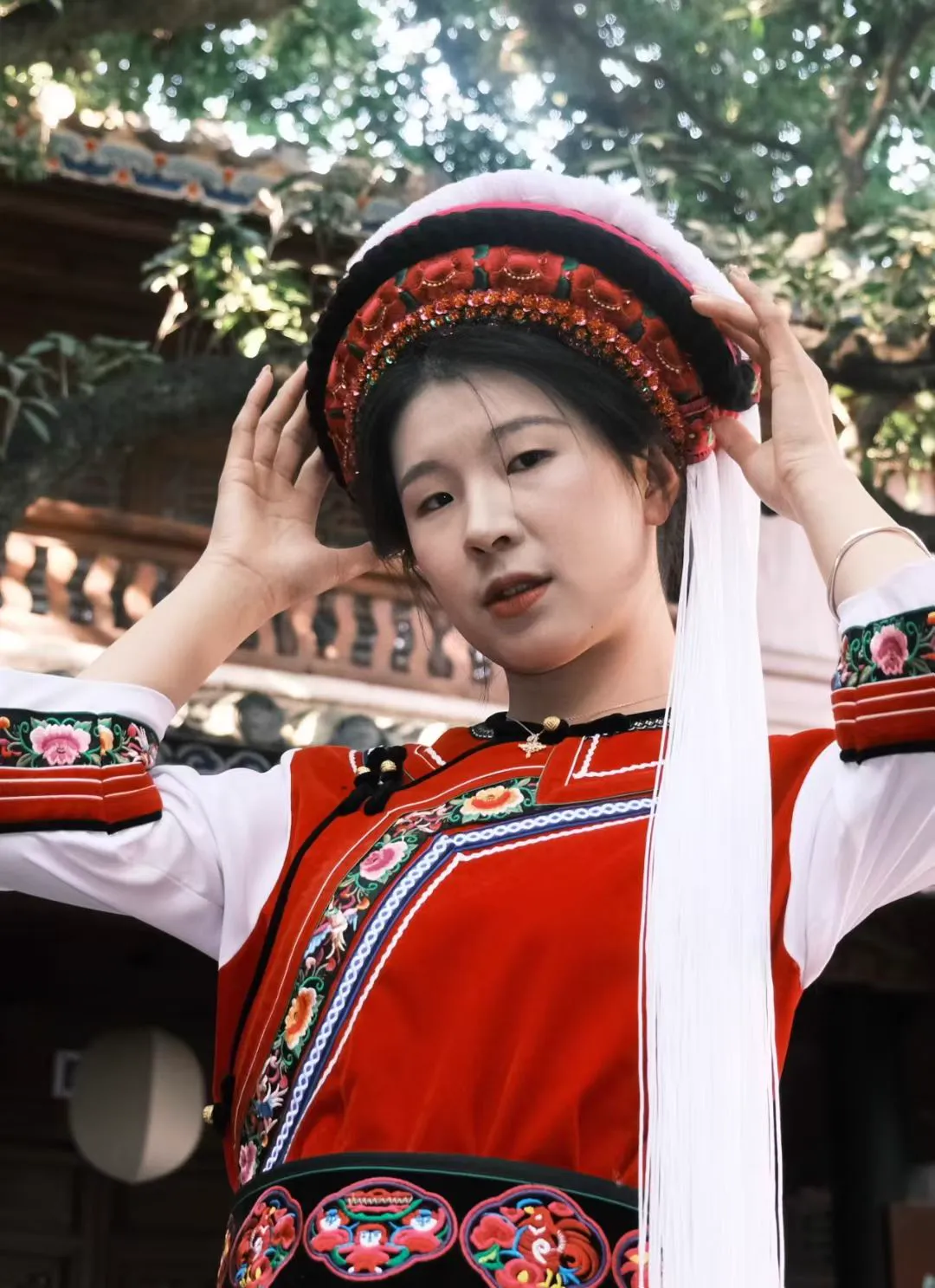
The headdress of Bai women is called “Wind, Flower, Snow, Moon,” symbolizing the snow of Cangshan, the moon of Erhai, and floral patterns.
The headdress consists of an embroidered headscarf, a white velvet cap, and colorful silk threads. It is the most representative part of Bai clothing.
The four characters “Wind, Flower, Snow, Moon” are both the scenery of Dali and the scenery on a Bai girl’s head. The wind of Xiaguan, the flowers of Shangguan, the snow of Cangshan, and the moon of Erhai are all worn on her head.
Every time I see a Bai girl wearing the “Wind, Flower, Snow, Moon” headdress, I think: this is not just a headdress—she is wearing the whole of Dali on her head.
Figure 2: Bai girl holding her “Wind, Flower, Snow, Moon” headdress—tassels and embroidery details in clear view
Embroidery: A Girl’s Heart
Bai women are skilled at embroidery, with exquisite stitching on pouches, aprons, shoe uppers, and headscarves.
Embroidery patterns are mostly auspicious motifs like peonies, phoenixes, butterflies, and auspicious clouds. An embroidered pouch is the crystallization of a Bai girl’s wisdom and skill.
A girl’s embroidery skill is often proof of her dexterity and cleverness. How well a pouch is embroidered reflects on the girl’s reputation. So Bai girls learn embroidery from childhood, stitching their hearts into every needle and thread.
Silver Jewelry: The Finishing Touch of Festival Dress
For festival dress, Bai women wear silver earrings, silver bracelets, silver neck rings, and other silver jewelry.
Silver jewelry is both decoration and a symbol of wealth, as well as an important part of a dowry. When a girl marries, she wears a full set of silver jewelry—both the dignity of her family and a blessing for her new life.
After making silver jewelry for so many years, what I love most is seeing Bai girls wearing silver jewelry. The gleaming silver earrings, bracelets, and neck rings, paired with red-and-white clothing—that beauty is beyond compare with any jewelry. Because it carries culture, heritage, and love.
Living Clothing: Still Worn, Still Embroidered
Bai clothing is still widely worn at festivals, weddings, song gatherings, and other occasions. It is a living expression of ethnic culture.
In Xizhou, Zhoucheng, and other places, there are Bai clothing makers and displays. Visitors to Dali can rent a Bai outfit for photos or buy an embroidered apron to take home.
The clothing has not entered a museum. It is still worn by Bai girls, walking between Cangshan Mountain and Erhai Lake. As long as Bai girls still wear it, Bai clothing is still alive.
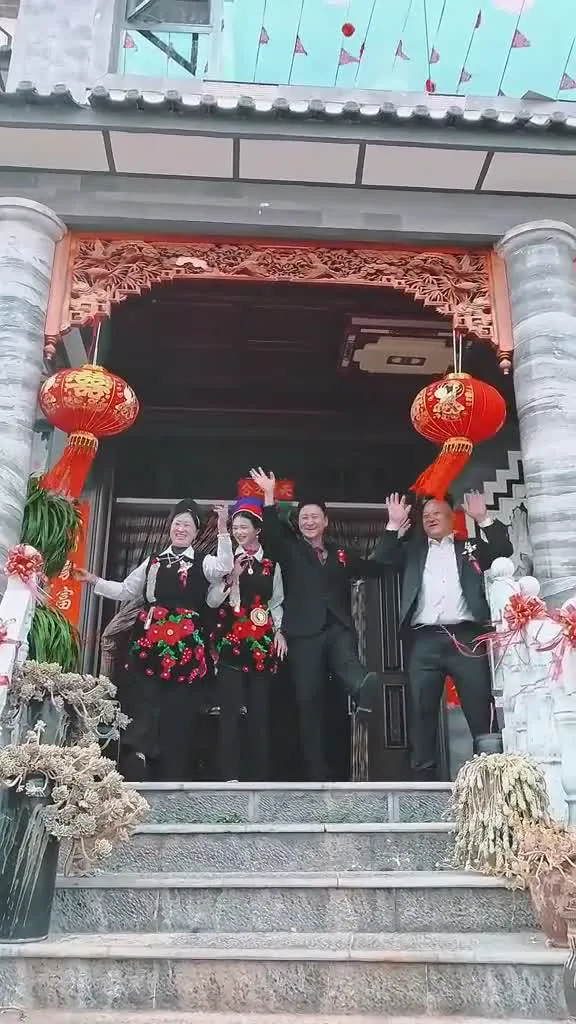
Figure 3: Bai girls in festival dress group photo at a doorway—embroidered aprons and headdresses
I am Mr. Jiang, founder of Yunsilver. My home is in Dali. The silver jewelry I make tells the stories of the Bai people. Website: yunsilver.com
Bai belongs to the Yi branch of the Tibeto-Burman group of the Sino-Tibetan language family. Today, about 1.24 million Bai people still speak it—more than 60 percent of our ethnic population.
The Bai language has many Chinese loanwords, which sound warm and familiar. Every time I return to Dali and hear elderly people chatting in Bai on the street, my heart warms—that is the sound of my childhood, the sound of home.
Sadly, fewer and fewer young people speak Bai. I often worry: in a few more decades, will Bai be spoken only by the elderly?
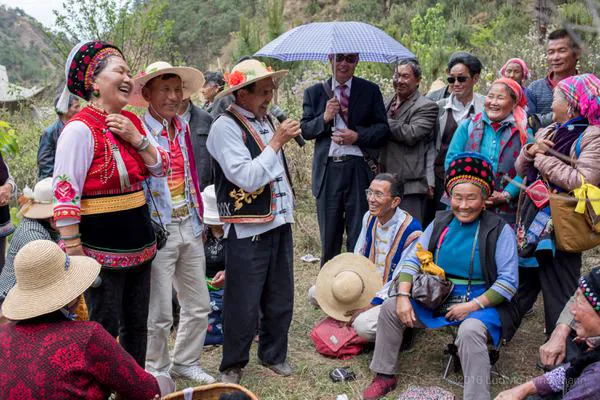
Figure 1: Bai antiphonal singing—men and women, young and old, singing outdoors. This is how the Bai language has been passed down, generation after generation, the sound I grew up with
Square Bai Script: A Heartbreaking History
Did you know that we Bai people once had our own written script, called the Square Bai Script?
It was created by imitating Chinese characters, and our ancestors wrote many books in it. The “Baigu Tongji” (General Records of the Bai Kingdom) was originally written in Bai script, and only later translated into Chinese.
But in the late Yuan and early Ming dynasties, Fu Youde and Mu Ying carried out a policy of cultural extermination in Yunnan, burning all official and folk collections of books. The Bai script was essentially wiped out.
Every time I think of this history, my heart aches. The death of a script means so many stories, so much wisdom, so many memories—just gone.
In 1955, people invented a Latin-alphabet phonetic Bai script based on the Chinese pinyin system, which was basically finalized after a revision in 1992. That leaves at least a trace of the Bai language, but it can never compare to the original Square Bai Script.
The Shanhua Stele: A Literary Treasure of the Bai People
The Shanhua Stele, fully titled “Ciji Shanhua: Yong Cang’er Jing” (Verses on Mountain Flowers: Singing of the Cangshan-Erhai Landscape), was erected in the first year of the Jingtai era of the Ming Dynasty (1450).
It was written by Yang Fu, a famous Bai litterateur of Dali in the Ming Dynasty. It was originally embedded in the Guanyin Hall of Shengyuan Temple in Qingdong Village, Xizhou, and now stands in the stele forest of the Dali Ancient City Museum.
The stele describes the beauty of Cangshan Mountain and Erhai Lake in elegant words. Every time I visit the Shanhua Stele, I wonder: more than 500 years ago, when Yang Fu stood between Cangshan and Erhai and wrote these words, what was he thinking? Was it the same as what I feel now—looking at the mountains and waters of my hometown, my heart full of love?
Carving Art: The Skill in Bai Hands
We Bai people are famous for our carving art, especially stone and wood carving.
The Yunnan Hall of the Great Hall of the People in Beijing uses Bai wood carving. Walk into a Bai village, and you will see exquisite wood and stone carvings on the gate towers, window lattices, and screen walls of every household.
Flowers, birds, fish, insects, and stories of people have all been carved by craftsmen into wood and stone. The carpenters and stonemasons of Jianchuan traveled far and wide, carrying Bai carving art across the country.
I often feel that Bai hands are the most skillful. Wood comes alive in their hands; stone gains stories in their hands.
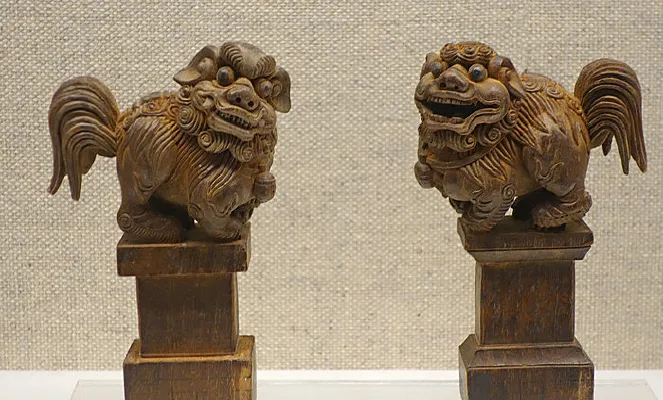
Figure 2: Bai wood-carved lions—Jianchuan wood carving, craftsmen carving flowers, birds, fish, insects, and stories of people into wood, the skill in Bai hands
Music and Dance: The Joy of the Bai People
We Bai people love to sing and dance.
Bai songs fall into three categories: “qu,” “diao,” and “qiang.” The most famous is “Ni Qiu Diao” (Loach Tune), known as the “mother of tunes.” We traditionally love antiphonal singing, and the Shibao Mountain Song Festival in Jianchuan, which originated in the Nanzhao period, remains to this day a place where young Bai men and women meet and fall in love.
Among Bai dances, the most famous is “Bawang Bian” (Overlord’s Whip), a lively group dance. At rural festivals, people also perform the “Bench Dragon” and the “Straw Hat Dance.”
Whenever there is a festival in the village, men and women, young and old, all come out to sing and dance. That kind of joy cannot be faked—it comes from deep inside.
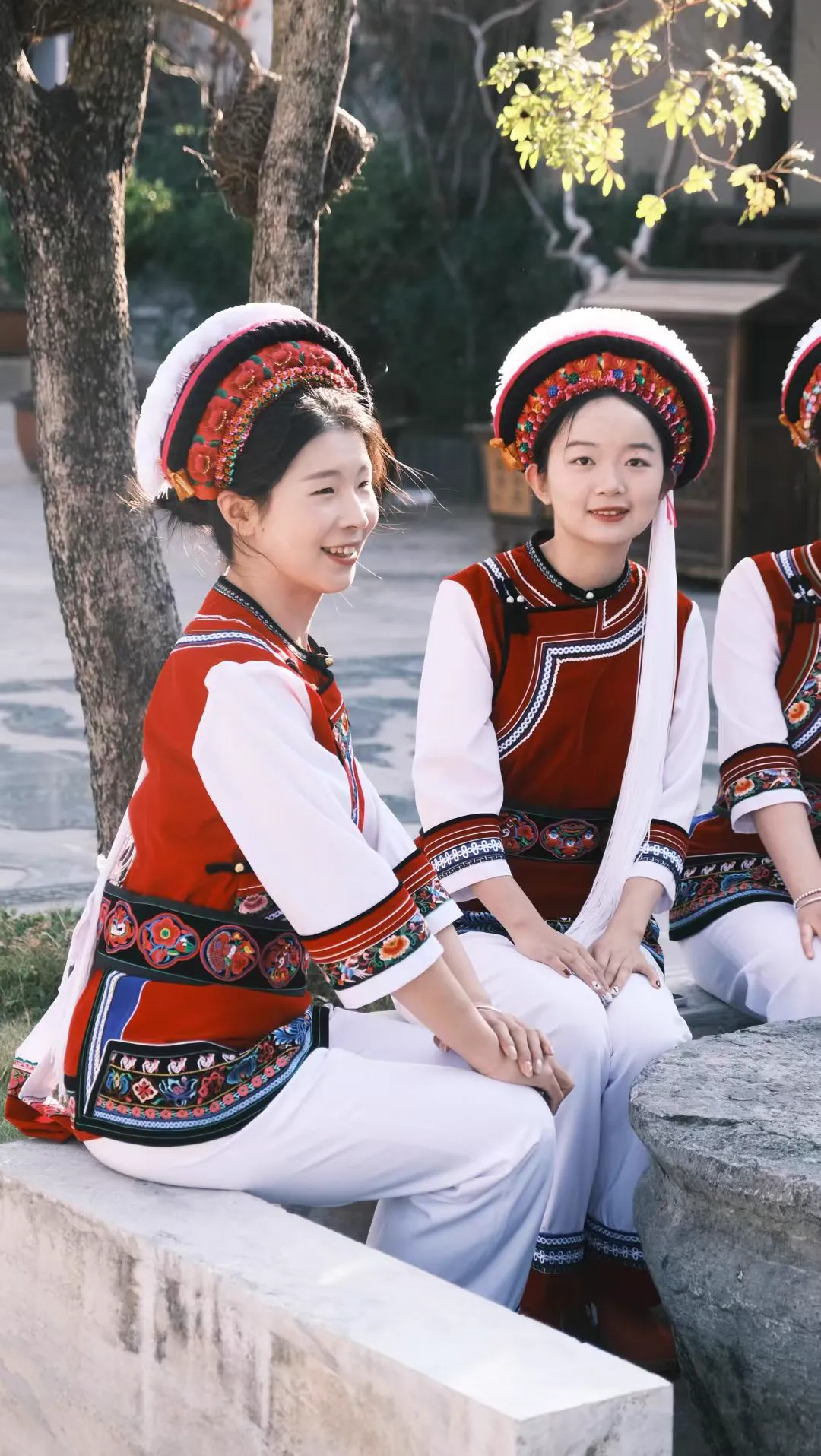
Figure 3: Two Bai girls sitting on a stone bench—festival gatherings of men and women, young and old
Intangible Heritage: Living Traditions
Our Bai intangible cultural heritage is all alive:
In Zhoucheng, tie-dye is still being dyed and worn; in Jianchuan, wood and stone carvings still go up on gate towers; in Dali, the Three-Course Tea is still served when guests arrive; and the tile cats on rooftops still guard our homes.
These are not specimens in a museum. They are part of our daily life. As long as Bai people are still here, these traditions will still be here.
Making silver jewelry is the same for me. Silver jewelry is not decoration—it is part of Bai life, part of our culture. I hope that through silver jewelry, more people will come to know the Bai people and love the Bai people.
I am Mr. Jiang, founder of Yunsilver. My home is in Dali. The silver jewelry I make tells the stories of the Bai people. Website: yunsilver.com
I often tell my friends that my hometown, Dali, is home to a gentle and resilient people—the Bai.
The Bai are China’s 14th largest ethnic group. In the 2020 census, there were 2.09 million Bai people across China, of whom 1.56 million live in Yunnan—more than 80 percent. The rest are scattered in Guizhou, Hunan, and elsewhere, but their roots are all by Erhai Lake.
We Bai call ourselves “Baihuo,” “Baizi,” and “Baini.” In historical records, we were once called “Baiman” and “Bairen,” and after the Ming Dynasty, “Minjia.” The character “Bai” (white) comes from the Baizi Kingdom of the Jin Dynasty—our first political regime, which lasted more than 400 years through 17 kings.
In our language, “Bai” means noble, pure, and clean. We love white clothing, live in white-walled houses, and our hearts are white as well.
4,000 Years Ago, My Ancestors Already Lived by Erhai Lake
Do you know that 4,000 years ago, my ancestors were already living by Erhai Lake?
There is a cave site on Malong Peak of Cangshan Mountain, called the Malong site, home to the Malong people. These are the oldest Bai ancestors that archaeology has found. We call them the “Erhai people.”
The Erhai people include the Malong people of Cangshan, the Baiyang people of Binchuan, the Dabona people of Xiangyun, and the Haikou people of Jianchuan. They created Yunnan’s earliest bronze civilization, fishing, farming, and making pottery by Erhai Lake, passing their way of life down through generations.
Every time I stand by Erhai Lake, looking at the snow on Cangshan and the water of Erhai, I wonder: 4,000 years ago, did my ancestors also stand here, looking at the same mountains and waters?
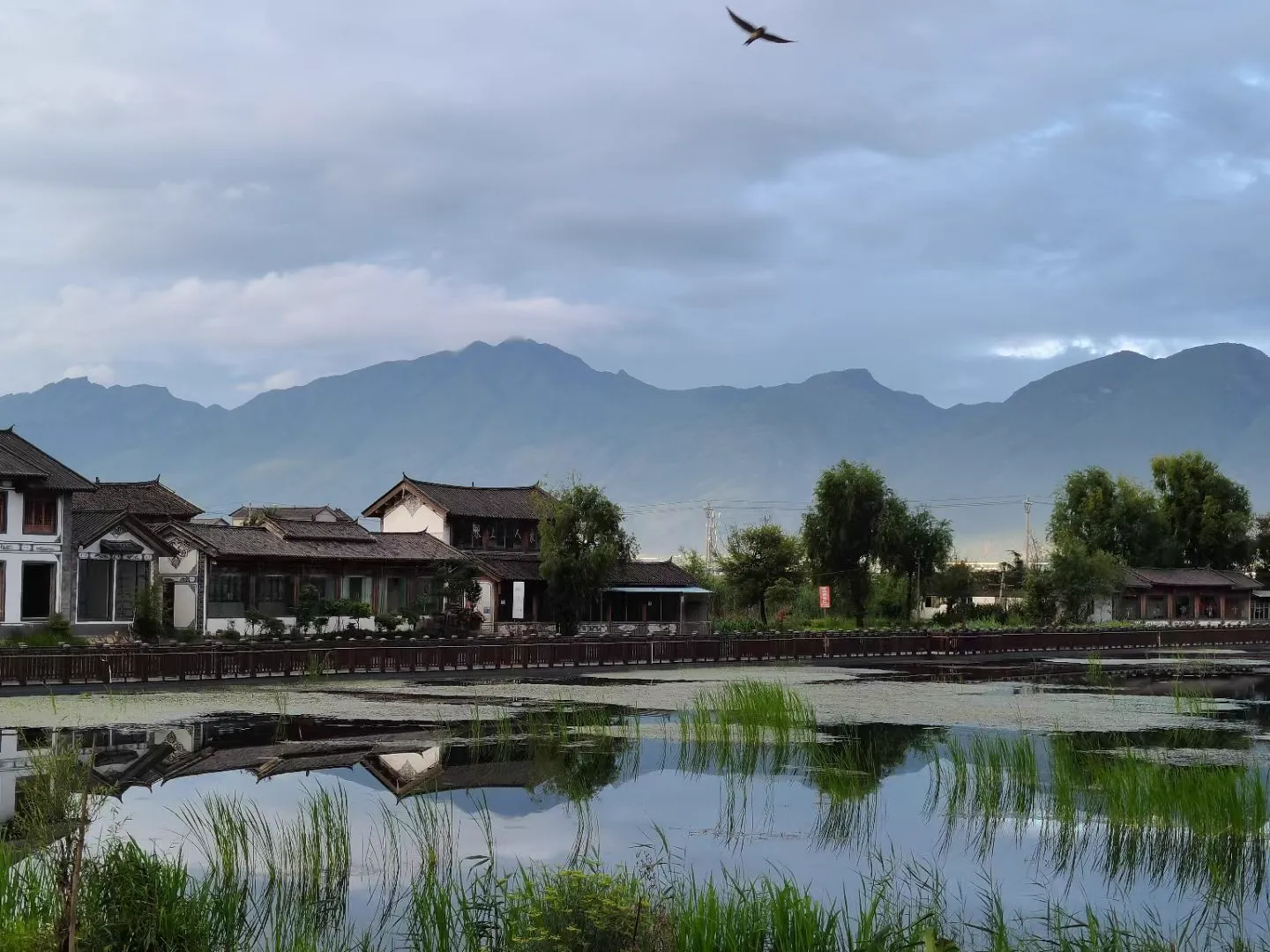
Figure 1: Bai village by Erhai Lake—where my ancestors have lived for 4,000 years
The Jiulong Legend: Where We Come From
We Bai people have a beautiful legend, called the Jiulong legend.
According to legend, our ancestor was Shay i, the holy mother of Ailao Mountain. Shay i became pregnant after touching a sunken log in the water and gave birth to 10 children, of whom the descendants of Jiulong became the Bai people.
During the Ming Dynasty, Bai people’s tombstones were often engraved with the three characters “Jiulongzu” (Jiulong clan). These three characters are our memorial to our ancestors and our answer to where we come from.
Legends are legends, but within them lies our love for our hometown.
The Nanzhao and Dali Kingdoms: Dali Was Once a Capital
Dali served as a capital for nearly 500 years.
Both the Nanzhao Kingdom and the Dali Kingdom established their capitals here. Nanzhao was founded by Bai and Yi ancestors. Duan Zongbang, the ancestor of the Duan family of the Dali Kingdom, is honored by us as the supreme god of the Bai people.
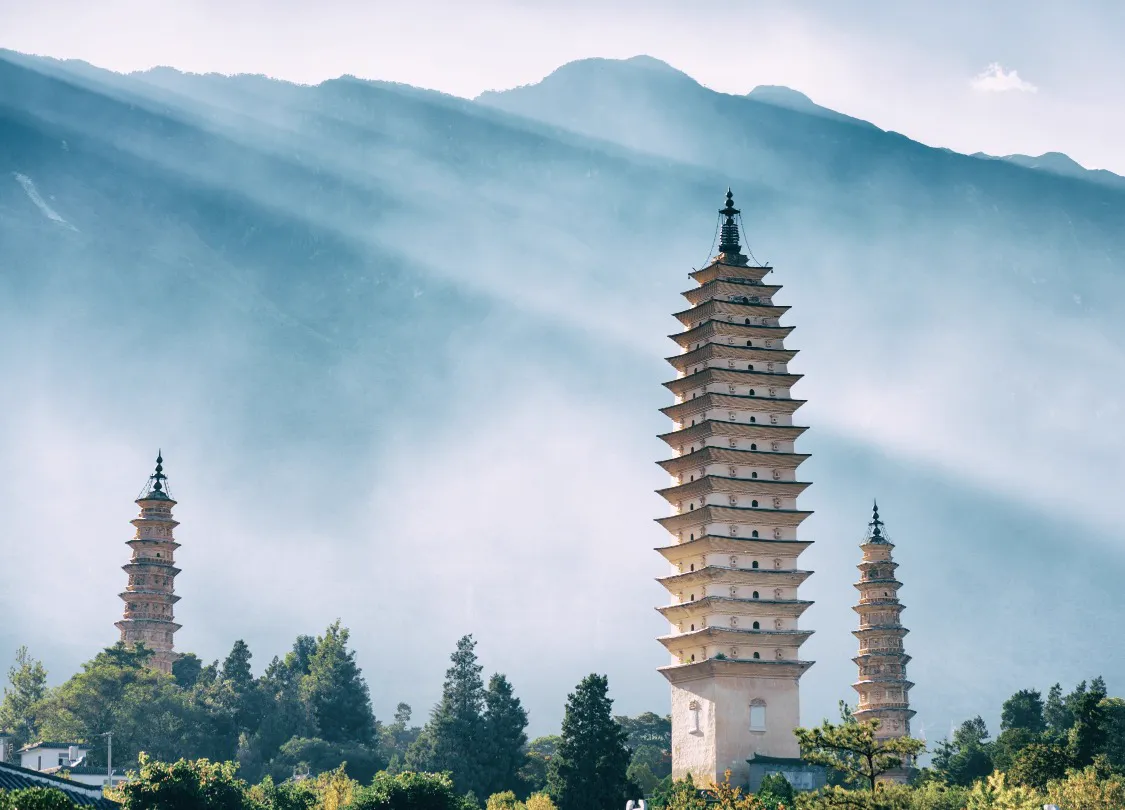
The Three Pagodas of Chongsheng Temple are what remain from that era. Every time I take friends to see the Three Pagodas, I say: look, these three pagodas have stood for more than a thousand years. They witnessed the prosperity of Nanzhao and the rise and fall of the Dali Kingdom, and they still stand here today, watching over us.
“Baiguo Yinyou” (Origins of the Bai Kingdom) is a collection of Bai folk legends about how the Nanzhao and Dali Kingdoms were established. It honors Guanyin as the protector god. A carved edition from 1706 once existed, and in 1957, scholar Fang Guoyu discovered it. This book is our Bai people’s own history.
Figure 2: The Three Pagodas of Chongsheng Temple—standing for over a thousand years, witnesses to Nanzhao’s prosperity and the Dali Kingdom’s rise and fall
Dali Today: My Home Is Still There
In 1956, the Dali Bai Autonomous Prefecture was established. In 1982, Dali City was listed among China’s first batch of National Historical and Cultural Cities.
Today, Cangshan is still there, Erhai is still there, Bai villages are still there, and the sound of silversmiths’ hammers is still there.
I often think that no matter how far I travel, Dali will always be my home. The water of Erhai, the snow of Cangshan, Bai songs, and the sound of silversmiths’ hammers—these are all carved into my bones.
From the Erhai people of 4,000 years ago to me today, the history of us Bai people is a history of civilization on the shores of Erhai Lake. And I am honored to be a page in this history.
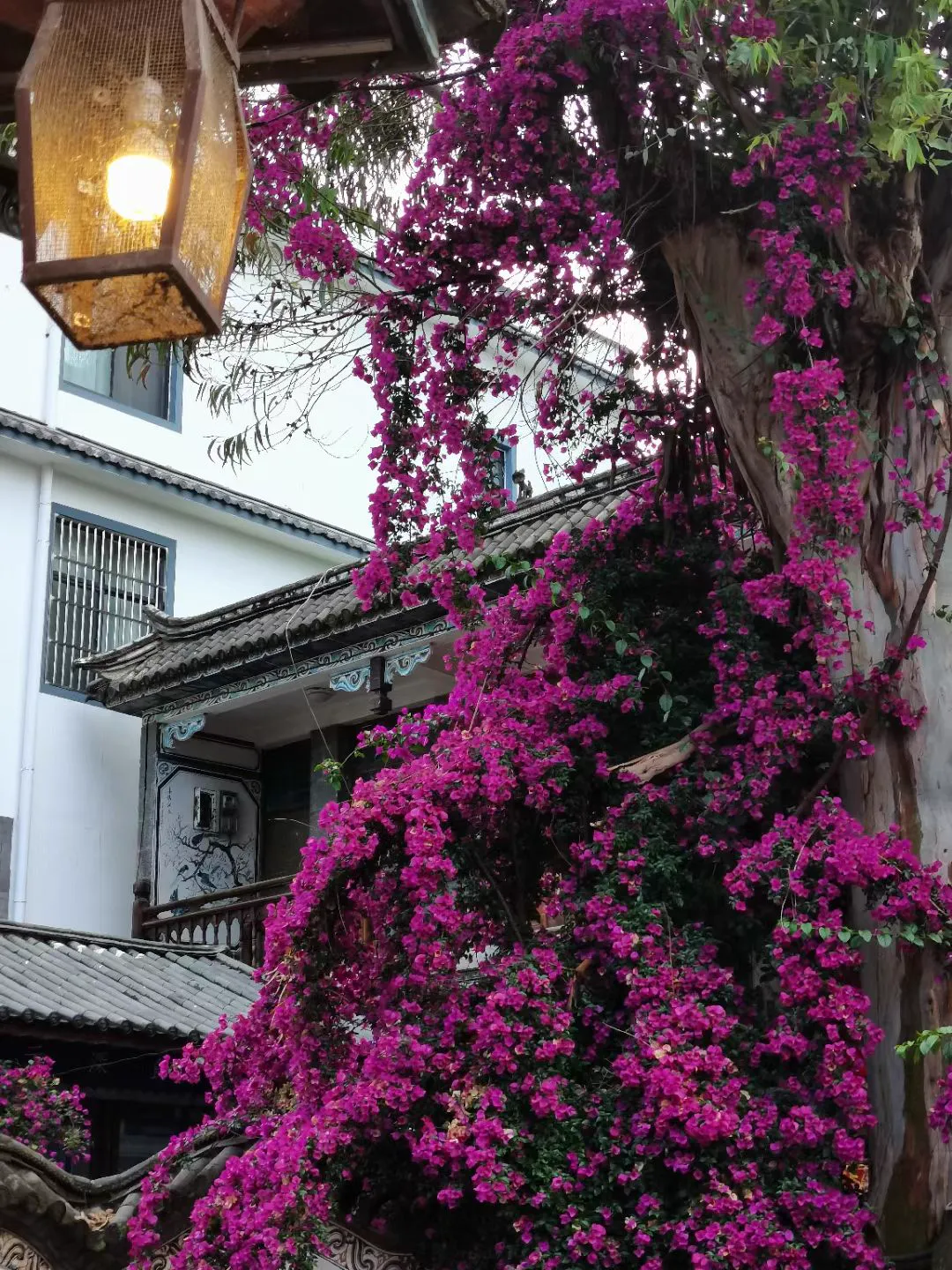
Figure 3: Bai residence with bougainvillea—Dali today, my home is still there
I am Mr. Jiang, founder of Yunsilver. My home is in Dali. The silver jewelry I make tells the stories of the Bai people. Website: yunsilver.com
We Bai also have a custom of matrilocal marriage (the groom marries into the bride’s family). A son-in-law who marries into his wife’s family enjoys the same social status as any other man. He is respected by neighbors and the bride’s family, has the right to inherit the wife’s family property, and bears the responsibility of caring for his wife’s parents. At the time of engagement, the bride’s family elders publicly change the groom’s surname to match his wife’s, and assign him a generational rank according to his wife’s family. There is a folk saying: “Send the son away, welcome the son-in-law in.”
Crying Marriage: The Most Moving Song Before a Daughter Leaves Home
At a Bai wedding, there is one most moving moment, called crying marriage.
Before the bride leaves home, she sings crying marriage songs with her mother and sisters, expressing her reluctance to leave her family and her gratitude for her parents’ upbringing. The crying marriage songs include “crying for parents,” “crying for ancestors,” and “crying for the matchmaker.”
Crying marriage is not really crying out of sadness. It is a ritual, a form of expression. A daughter is about to leave the home where she grew up. Her heart holds reluctance, gratitude, and hope for the future—all sung into the crying marriage songs.
When a mother listens to her daughter’s crying marriage song, her heart is filled with mixed feelings. A daughter raised for more than twenty years is getting married today. How can a mother not feel heartache? But heartache aside, blessings must still be given.
Once the crying marriage songs begin, the whole family has tears in their eyes. This is the most moving part of a Bai wedding—not the noise and excitement, but family love.
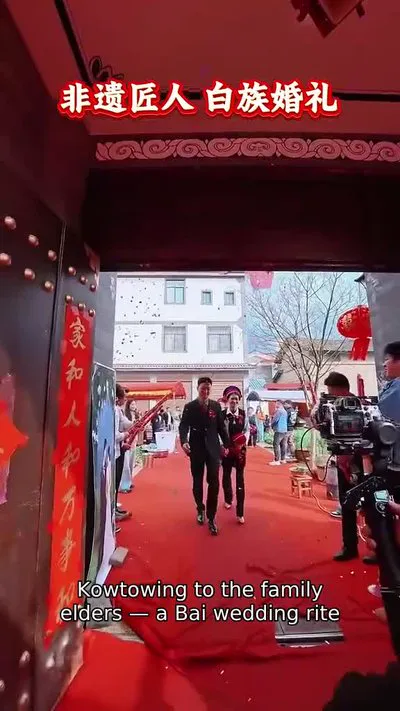
Bai wedding video still: the couple walks the red carpet, with bilingual subtitles.
Carrying the Bride: The Most Unforgettable Moment
The groom carrying the bride is the signature moment of a Bai wedding.
Whenever the bride and groom pass an intersection, people stop and wait for the groom to carry the bride in a figure-eight pattern. In some places, the best man greets the bridal party with suona horn music. When they arrive at the bride’s home, the suona must be played six times before the bride’s relatives come out to greet them.
I have attended many Bai weddings. Every time I see the groom carrying the bride across an intersection, my heart is moved. Carrying the bride is not just physical labor. It is the groom’s promise to the bride—from now on, I will carry you through life’s journey.
That kind of promise is made through action, not just words.
The Wedding Day: Celebration in Suona Music
On the wedding day, the groom’s family sets up a banquet early in the morning. After guests enjoy good food and rice wine, the groom and his best man toast table by table, with suona music playing continuously.
When the bride arrives at the groom’s home, she first goes upstairs to dress up, then enters the bridal chamber. Two boys of about ten years old rush into the bridal chamber holding pine torches, followed by the bride accompanied by her bridesmaids running into the chamber. Everyone playfully pinches the bride and teases her, full of joy.
The wedding celebration features Bawangbian dance and Dabenqu storytelling performances. Guests share tangyuan (glutinous rice balls), symbolizing reunion.
The liveliness of a Bai wedding comes from the heart. It is not for show. It is genuine happiness, genuine blessing.
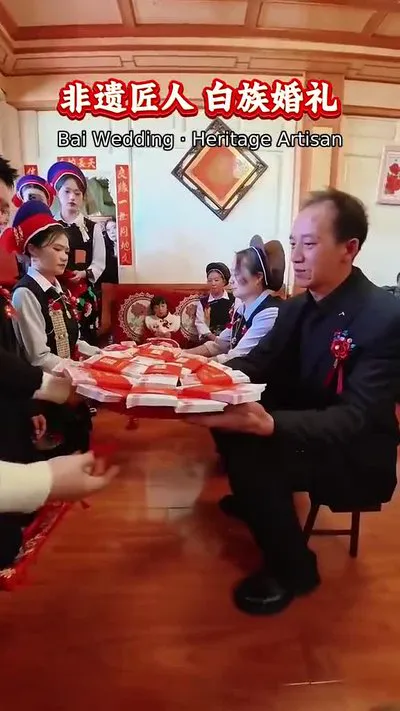
Bai wedding video still: the indoor tea ceremony, with Bai women in festive dress.
Silver Dowry: The Centerpiece of a Bai Wedding
Silver jewelry holds an important place in a Bai bride’s dowry, including silver bracelets, silver neck rings, silver earrings, silver headdresses, and a complete set of silver pieces.
Silver jewelry is both a symbol of wealth and a family inheritance and blessing for the bride. At a Bai wedding, the bride wears a complete set of silver jewelry, symbolizing good fortune and prosperity.
After years of making silver jewelry, what I love most is seeing a bride wearing a full set of silver jewelry. Sparkling silver earrings, bracelets, and neck rings, paired with a red and white wedding dress—that kind of beauty surpasses any other jewelry.
Because inside it lies the love of her parents’ family, the inheritance of the family, and blessings for a new life. A complete set of Bai wedding silver jewelry is often the result of years of savings by the bride’s family, and it is the most dignified dowry a young woman can bring when she marries.
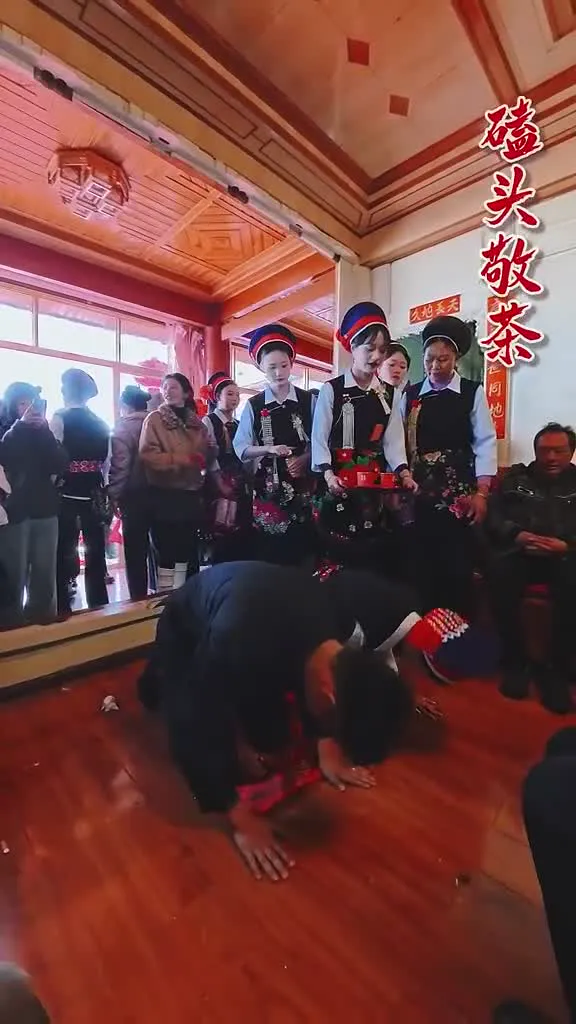
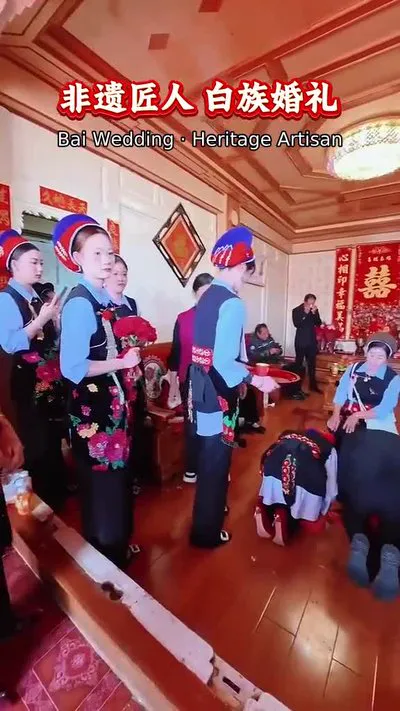
Bai wedding video still: the kowtow ceremony.
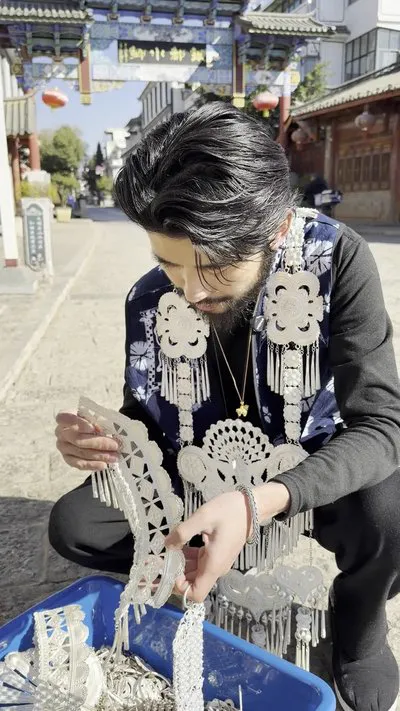
Mr. Jiang wearing a full set of silver jewelry under a silver archway—a classic example of bridal silver accessories.
On the third day after the wedding, the bride returns to her parents’ home (the return visit), accompanied by the groom or picked up by him the next day.
I am Mr. Jiang, founder of Yunsilver. My home is in Dali. The silver jewelry I make tells the stories of the Bai people. Website: yunsilver.com