
March Street Fair: A Thousand-Year-Old Market
The March Street Fair is the grandest festival for us Bai people.
It is held from the 15th to the 20th day of the third lunar month each year, at the foot of Zhonghe Peak of Cangshan Mountain, west of Dali City. It originated in the Tang Dynasty as a Guanyin temple fair and has a history of more than a thousand years.
Li Yuanyang’s “Yunnan Gazetteer” of the Ming Dynasty records: “The Guanyin Market, held on the 15th day of the third month at the foot of Cangshan, trades goods from all provinces. Since the Yonghui era of the Tang Dynasty to today, dynasties have changed, but this market has never changed.”
In 1991, the March Street Fair was designated as the “March Street Ethnic Festival.”
Originally a Buddhist temple fair with sutra chanting and worship, the March Street Fair gradually evolved into a goods exchange fair, becoming the largest trade event in western Yunnan, while also hosting horse racing, archery, song and dance, dragon boat racing, and other cultural and sports activities.
Since childhood, I have followed adults to the March Street Fair. Crowds of people, shoulder to shoulder, selling everything imaginable. That kind of excitement, that kind of popularity, is something you cannot experience on ordinary days.
Torch Festival: My Favorite Flame
The Torch Festival is my favorite festival.
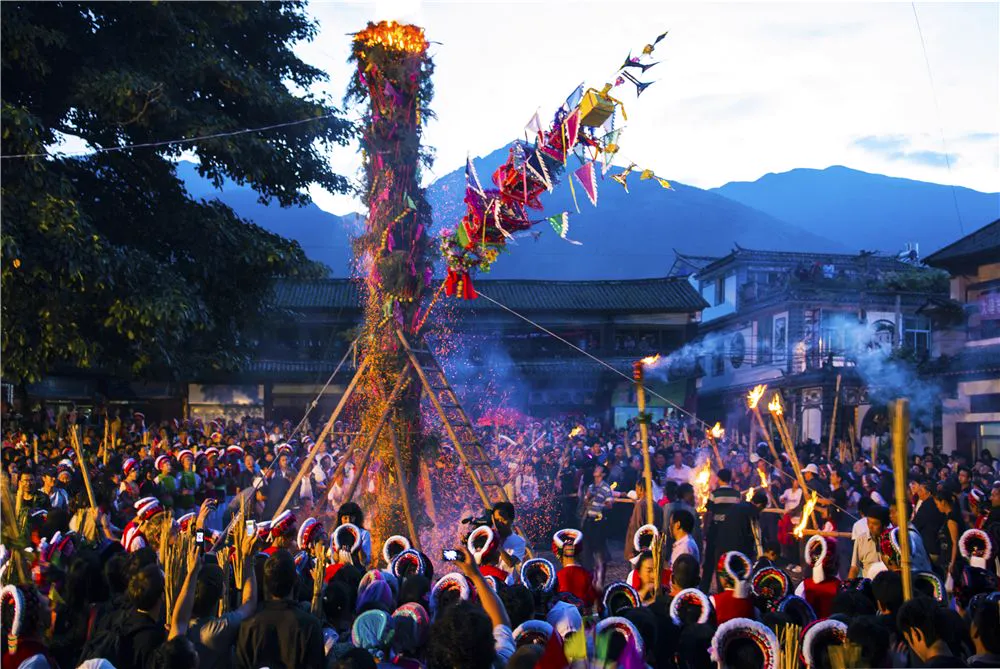
In the Bai language, it is called “Fuwangwu,” held on the 25th day of the sixth lunar month each year. On the eve of the festival, the whole village erects a large torch, ten to twenty meters high, made from a pine tree trunk, wrapped with wheat straw and pine branches, with a flag on top and three paper lanterns strung on the flagpole, symbolizing promotion through three levels.
On the festival day, men and women, young and old, worship ancestors through activities like paying respects to the torch, lighting the torch, playing with the torch, and jumping over the torch, praying for abundant harvests and thriving livestock.
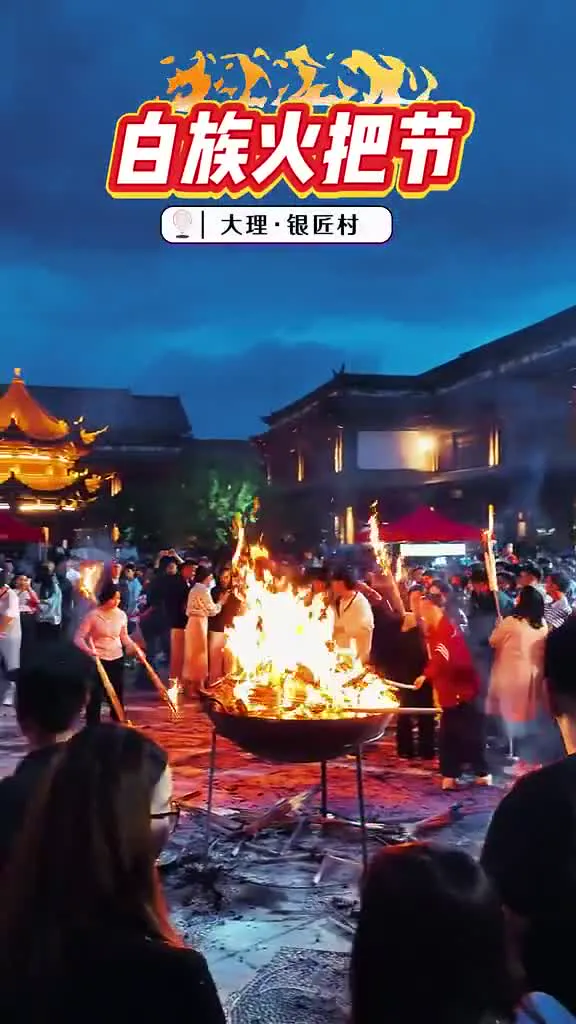
At noon, people take small torches, paper money, incense, candles, and offerings to ancestral graves to sweep tombs and pay respects; before sunset, they admire the torches and horse racing, running around the torch three times; at nightfall, elders lead the sacrifice, and brave young men climb the large torch to light it; the climax is playing with torches, when young people grab pine resin powder and sprinkle it on the torch, flames licking toward each other, called “offering a handful,” believed to burn away bad luck; the finale is jumping over torches, when young men and women leap over bonfires, praying to ward off disasters and evil.
Every time the torch is lit, the whole village cheers. Flames shoot to the sky, illuminating the night and every face. That feeling is truly hard to describe in words.
Raosanling: Pilgrimage to the Divine Capital
Raosanling is held in late April of the lunar calendar each year, lasting three to four days.
Thousands of men and women, young and old, dressed in ethnic finery, playing instruments, singing and dancing, gather at the “Divine Capital” Shengyuan Temple to worship.
According to legend, Duan Zongbang, a general of Nanzhao and ancestor of the Duan family of the Dali Kingdom, is the supreme god of the Bai people. His temple is called the “Divine Capital,” built at Shengyuan Temple on Shangyang Creek. Over three days, pilgrims visit Shengyuan Temple, Jingdi Temple (Jinkui Temple), and Chongsheng Temple respectively.
During Raosanling, the whole of Dali comes alive. Songs, music, and laughter drift between Cangshan Mountain and Erhai Lake.
Shibao Mountain Song Festival: Love Songs Across the Valley
Held for three days at the end of July of the lunar calendar each year at Shizhong Temple on Shibao Mountain in Jianchuan.
Tens of thousands of young men and women gather in groups to sing antiphonal mountain songs, using three-stringed instruments and songs to convey affection. The song festival originated in the Nanzhao period and is an important occasion for Bai young people to fall in love and make friends.
When I was young, I also went to the Shibao Mountain Song Festival. That feeling was wonderful—singing across the valley, getting to know each other through song, and falling in love through knowing each other. Mountain songs are how we Bai people fall in love.
Festival Density: Our Life Is Festivals
The Bai region has many festivals, temple fairs, and song gatherings.
From the Spring Festival to the 18th day of the first lunar month, there are festivals almost every day and dragon lantern dances every night; from the first month to the start of transplanting, there are temple fairs every month, with villages welcoming and sending off their Benzhu gods for Benzhu Festivals.
Our Bai year is spent in festivals. Every festival is a reunion, and every reunion is a celebration.
I am Mr. Jiang, founder of Yunsilver. My home is in Dali. The silver jewelry I make tells the stories of the Bai people. Website: yunsilver.com
Leave a Reply